
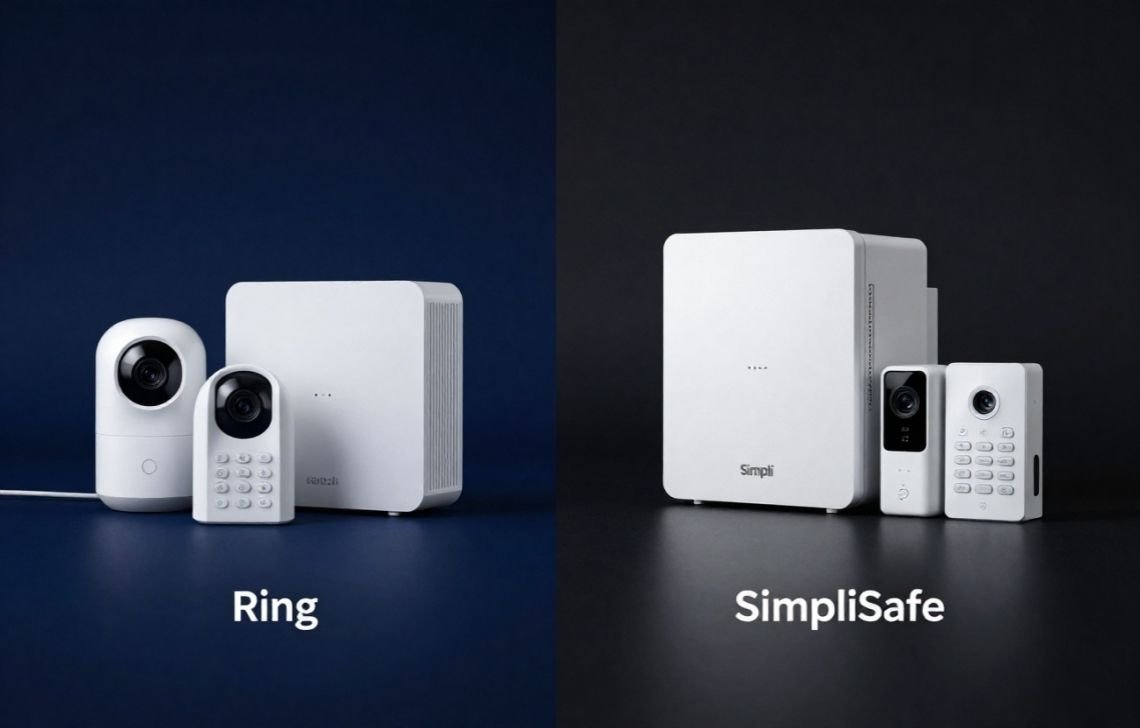
Choosing a home security system is one of the most significant decisions a homeowner can make. It is not just about buying gadgets; it is about ensuring the safety of your family and the protection of your property. In the current market, the Ring vs SimpliSafe debate dominates the conversation, leaving many users frustrated by conflicting reviews and marketing jargon.
As a senior smart home consultant, I don’t just look at spec sheets; I test these systems in the trenches. My testing environment is a high-interference home with over 75 active WiFi devices and dozens of RF wireless peripherals. In a wireless-heavy world, reliability is the only metric that truly matters when your family’s safety is on the line.
When searching for the best home security system, you likely prioritize professional monitoring and a seamless DIY installation. This guide will dismantle the marketing claims and look at how these two giants perform when pushed to their technical limits. Whether you are moving into a new home or upgrading an old alarm, understanding these technical nuances is critical for a secure future.
At a Glance: The Comparison Matrix
The following table provides a direct comparison of the fundamental metrics for both systems. This matrix is designed for quick navigation and highlights the primary value propositions of each brand based on my technical evaluation.
Category | Ring Alarm | SimpliSafe |
Standard Hardware Kit Price | ~$359.87 | ~$539.84* |
Monthly Monitoring | $10/mo or $100/yr | $24.99/mo |
Connectivity | Ethernet/WiFi + Range Extender | WiFi Only |
Self-Monitoring | App notifications included | Paid plan required for app use |
Smart Home Support | Amazon Alexa-centric | Echo, Google Home, August Lock |
Connectivity and Reliability: The "Wireless Interference" Factor
In a modern household “loaded” with wireless devices, connectivity is where a security system proves its worth. During my long-term testing, a significant technical divide emerged between Ring and SimpliSafe regarding how they handle dense wireless environments. My home, which runs over 75 WiFi-connected devices, proved to be a breaking point for SimpliSafe’s architecture.
SimpliSafe relies exclusively on a WiFi connection for its base station and its own proprietary wireless frequency for sensors. In my environment, this led to frequent and frustrating “wireless interference” warnings from the base station. More concerningly, the system would sporadically report that doors or windows were “open” when they were actually closed, a terrifying prospect for any homeowner.
Ring addresses these reliability issues through two critical hardware choices that cater to complex environments. First, the Ring Base Station includes an Ethernet port, allowing for a hardwired connection to your router. This removes one high-priority device from the crowded 2.4GHz wireless spectrum and ensures a faster, more stable heartbeat for the entire system.
Furthermore, Ring includes a “Range Extender” module in their standard 5-piece starter kit. This module plugs into a standard wall outlet and effectively boosts the signal between the base station and distant sensors. Because SimpliSafe lacks a range extender option, users in large or complex homes are limited by the native range of the base station, which can lead to the connection failures I experienced.
Hardware Deep-Dive: Sensors, Listeners, and Extenders
While both companies offer the standard array of security hardware, their design philosophies and device varieties differ significantly. As a consultant, I look at the physical durability and the logic behind the detection methods.
Physical Build and Sensors
In my hands-on testing, I found the Ring entry sensors to be notably larger and more robust than SimpliSafe’s smaller, more delicate counterparts. While some users might prefer the low profile of SimpliSafe hardware, the Ring sensors feel more substantial and less prone to accidental damage. Both systems offer the essentials: keypads, motion detectors, and panic buttons to round out their basic security footprints.
Detection Philosophy: Smoke, CO, and Glass Breakage
The two companies take very different approaches to environmental hazards and glass break detection. SimpliSafe offers dedicated, battery-operated Smoke and CO detectors that function as standalone units within their ecosystem. They also provide a physical Glass Break sensor that listens for the specific frequency of shattering glass in a room.
Ring utilizes a “Listener” approach, which I find technically superior for homes that already have integrated, wired smoke detectors. Instead of replacing your hardware, you place a Ring Smoke and CO Listener next to an existing unit, such as a Onelink Safe and Sound detector. When your existing detectors sound, the Ring Listener hears the siren and triggers the entire alarm system, alerting the monitoring center immediately.
The Camera Disparity
One of the biggest hardware differences lies in the camera ecosystems. Ring offers an massive variety of choices, including multiple indoor, outdoor, and spotlight cameras with various power options. SimpliSafe is much more limited, offering only one indoor camera and a doorbell camera, with no dedicated high-performance outdoor mounting options available at this time.
Installation and User Experience
Both Ring and SimpliSafe are champions of the “contract-free” and “ala-carte” model. You purchase the hardware you need and can add components at any time without being locked into a long-term agreement. The installation process for both is designed to be completed in approximately one hour, even for those who aren’t tech-savvy.
For the highest success rate with the Ring system, I recommend a specific “one-at-a-time” logic. Set up the base station first, let it update its firmware, and then add each sensor individually before moving to the next. This prevents the system from becoming overwhelmed during the initial pairing phase and ensures every contact sensor is properly synced.
Regarding user feedback, SimpliSafe’s base station provides more frequent voice prompts than Ring, which can be helpful during the initial walkthrough. However, it is important to note a shared limitation: neither system currently announces specific sensor names. You will hear a generic chime, but neither will state “back door open,” which is a feature I often miss from older, legacy security systems.
Pricing and Professional Monitoring: The Long-Term Value
When evaluating the total cost of ownership, Ring offers a significantly lower price point for both hardware and ongoing services. The price gap is even more pronounced when you look at the “Year 2” outlook and beyond.
Hardware Cost and the "App Wall"
A typical Ring Alarm setup may cost approximately 359.87**, whereas a comparable SimpliSafe system can reach **539.84 or even $638.84 without promotions. The most significant hidden cost, however, is what I call the “App Wall.” SimpliSafe does not allow you to use their smartphone app to arm, disarm, or receive notifications unless you pay for their most expensive monitoring plan.
In contrast, Ring allows all users to receive app notifications and control the system via the app for free. This makes Ring the only viable choice for those who want to “self-monitor” their home without a monthly bill. If you do choose to pay, Ring’s professional monitoring is a flat $10 per month or $100 per year, which is a massive discount compared to SimpliSafe’s $24.99 monthly rate.
Savings Highlight: 12-Month Comparison
Expense | Ring Alarm | SimpliSafe |
Hardware (Est. Custom Kit) | $360.00 | $540.00 |
1 Year Monitoring | $100.00 | $299.88 |
Total Year 1 | $460.00 | $839.88 |
Potential Savings | $379.88 | -- |
In Year 2, the savings increase further. By choosing Ring, you save nearly $25 every single month, which eventually pays for the entire cost of the hardware.
Smart Home Integration: Alexa, Google, and Beyond
In the realm of smart home connectivity, your choice of ecosystem may dictate your security choice. Because Ring is an Amazon-owned company, it features deep, native integration with Alexa. You can arm the system via voice commands or use Echo devices as extra sirens.
However, I was surprised to find that Ring lacks native Alexa Routine support, meaning you can’t naturally include an “arm” command in a “Goodnight” routine. To solve this, I use a workaround via the SimpleCommands app, which allows Ring to be triggered by routines across both Alexa and Google Home. Without this workaround, the Ring experience can feel somewhat isolated for power users.
SimpliSafe offers native support for Google Home and integrates directly with the August Smart Lock Pro. Ring, while supporting locks from Kevo and LockState, currently lacks native support for the August ecosystem. For Apple users, both systems can be brought into HomeKit, but only if you are willing to use a Homebridge plug-in on a dedicated server.
The Pros and Cons: A Transparent Breakdown
Ring Alarm Pros
- Most Affordable: Professional monitoring is only $100/yr and covers unlimited cameras.
- Superior Reliability: The Ethernet port and included Range Extender are vital for large homes.
- No Paywalls: All app features are available even if you don’t pay for monitoring.
- Camera Variety: Dozens of indoor and outdoor camera options to choose from.
Ring Alarm Cons
- Sensor Size: Contact sensors are larger and more visible than SimpliSafe’s.
- Software Gaps: No native Alexa Routine support without the SimpleCommands workaround.
No Native Glass Break: Requires Amazon Echo “Guard Mode” rather than dedicated hardware.
SimpliSafe Pros
- Dedicated Glass Breakage: Physical sensors specifically tuned for shattering glass.
- Third-Party Integration: Native support for August Smart Locks and Google Home.
- Voice Guidance: More intuitive voice prompts from the base station during daily use.
- Key Fobs: Offers a physical fob for those who dislike using keypads or apps.
SimpliSafe Cons
- The App Wall: You cannot use the mobile app at all without the $24.99/mo plan.
- Connectivity: Prone to interference and false “open” reports in high-traffic wireless homes.
- Expensive Monitoring: Costs more than double what Ring charges for similar services.
Verdict: Which One Should You Choose?
Both systems offer professional-grade protection, but they cater to very different household needs. In my professional opinion, the “it just works” factor leans heavily toward one side for the average modern home
Choose Ring if:
You have a home filled with wireless devices, a large floor plan, or multiple floors. If you already use Amazon Alexa or want the absolute lowest long-term cost, Ring is the clear winner. The inclusion of the range extender and the Ethernet port makes it the only system I trust in a high-interference environment.
Choose SimpliSafe if:
You have a small, simple apartment or a home where the base station will always be in close proximity to every sensor. It is a strong candidate if you specifically need native Google Home support or if you are already invested in the August Smart Lock ecosystem. Just be prepared to pay a premium for the privilege of using their smartphone app.
FAQs
Does Ring work if the internet goes down?
Yes. The Ring Base Station features a cellular backup battery and radio. As long as you have the Ring Protect Plus plan ($100/yr), the system will use cellular towers to send alerts even if your internet is cut.
Can I use SimpliSafe without a subscription?
Technically, yes, but you lose almost all functionality. Without a subscription, you cannot use the app to arm/disarm the system or receive notifications. It effectively becomes a “local-only” noisemaker.
Which system is better for large houses?
Ring is the definitive choice for large houses. The Range Extender included in every kit ensures that sensors on the far side of the house stay connected, a feature SimpliSafe lacks.
Do these systems require a contract?
No. Both Ring and SimpliSafe offer month-to-month monitoring. You can cancel at any time without paying any termination fees, making them both excellent for renters and homeowners alike.