
A smart thermostat is a Wi-Fi-enabled device that allows for remote HVAC control and automated energy management. By connecting to the internet, it optimizes heating and cooling based on your schedule, occupancy, and local weather to reduce energy costs.
Once considered novelty gadgets, smart thermostats have become essential household tools. This shift is driven by a dual demand: homeowners want the convenience of remote management and a solution to rising energy costs. By transforming the thermostat into a data-driven hub, users can achieve precise comfort without the waste associated with manual systems.
Defining the Smart Thermostat
A smart thermostat acts as a partner in home comfort, connecting directly to the internet to optimize HVAC performance. Unlike traditional units that act as simple on/off switches, a smart thermostat is a sophisticated interface for your HVAC system’s control board.
Traditional vs. Smart: The Cruise Control Analogy
Standard thermostats operate with a binary “all or nothing” logic. Using older models is comparable to driving a car by alternating between going 100 mph or slamming on the brakes; the system runs at full capacity until it hits a target, then shuts off abruptly. A smart thermostat provides “cruise control” for the home, managing the HVAC system effectively to maintain a steady, efficient environment.
Common Use Cases
- Commuter Comfort: Triggering the cooling system while driving home so the house is at the perfect temperature upon arrival.
- Property Monitoring: Checking the status of a vacation home or rental property from anywhere in the world.
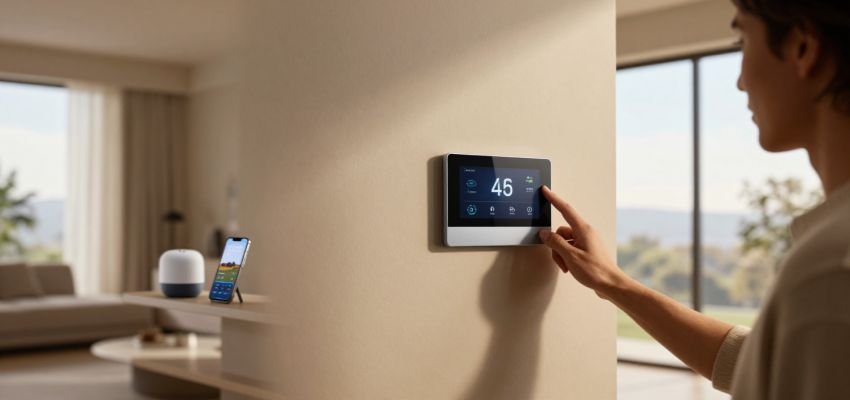
- Mobile Management: Adjusting the temperature from a tablet or smartphone without leaving bed.
How Does a Smart Thermostat Work?
The device connects to your home network to enable communication between the HVAC system’s control board and your external devices. It typically utilizes standard 5-conductor thermostat wiring to send signals that activate or deactivate heating and cooling components based on real-time data.
IAQ and Ecosystem Integration
Beyond temperature, advanced smart thermostats manage Indoor Air Quality (IAQ) devices. They can serve as a central controller for humidifiers, dehumidifiers, and ventilators to ensure a healthy living environment. They also integrate into broader smart home ecosystems, allowing for voice control via Alexa, Google Assistant, or Siri.
Sensors and Machine Learning
Smart thermostats use built-in and remote sensors to measure ambient temperature and detect occupancy. AI algorithms analyze these patterns to “learn” your daily routine, automatically configuring set points to maximize efficiency during times when the house is empty.
Essential Features for the Modern Homeowner
- Geofencing (Auto-away): This uses GPS or RFID cell phone location data to create a virtual perimeter. The thermostat automatically triggers “away” mode when you leave and “home” mode when you approach.
- Smart Scheduling: Unlike older programmable models with complex on-device menus, smart schedules are easily adjusted via intuitive apps.
- Advanced Comfort Cycles: Features like Allergy Clean or Quick Clean cycles and dedicated Humidity Control allow for tailored air filtration and moisture management.
- Energy Tracking & Runtime History: Reporting features provide detailed insights into your system’s runtime and usage patterns, offering tips to lower utility bills.
- Safety and Maintenance Alerts: The device maintains “Safety Temperatures” to prevent frozen pipes and sends critical alerts for filter changes or system health issues.
The Core Benefits of Upgrading
- Efficiency and ROI: On average, users save 8% on energy bills. ENERGY STAR® certified models can save 10% to 15% annually on heating and cooling costs.
- Convenience: The “set it and forget it” nature of machine learning allows for automated comfort with minimal manual input.
- Environmental Impact: Reduced energy consumption leads directly to a smaller household carbon footprint.
- Home Protection: System alerts provide peace of mind by notifying you of potential HVAC failures before they lead to structural damage.
Critical Considerations and Drawbacks
- Upfront Investment: Smart models carry a higher initial cost than manual or standard programmable units.
- Compatibility Hurdles: These devices are not compatible with all systems. Problems often arise with high-voltage baseboard heaters, millivolt systems (older dial-type thermostats), or proprietary communicating mini-splits.
- The “C-Wire” Requirement: Most smart thermostats require a “Common Wire” (C-wire) to provide constant power for the Wi-Fi module. If your current 5-conductor wiring lacks this, you may need an “add-a-wire” kit or professional assistance.
- Connectivity Dependency: If Wi-Fi goes down, you lose remote access and real-time updates, though the unit will typically continue to function as a standard wall-mounted controller.
Smart vs. Traditional vs. Programmable: A Comparison
Feature | Traditional | Programmable | Smart |
Control Method | Manual Dial/Knob | On-device Menus | Mobile App/Voice/AI |
Setup Difficulty | Very Easy | Complex | App-guided / Pro Recommended |
Energy Savings | Low/None | Moderate | High (8%–15%+) |
Key Tech | Analog Sensors | Basic Timers | Wi-Fi, AI, Geofencing, IAQ |
User Personas
- Traditional: Best for those who prefer zero technology interaction.
- Programmable: Best for those with extremely rigid, unchanging routines.
Smart: Best for homeowners seeking maximum ROI, tech integration, and those with erratic schedules.
How to Choose the Right Model
Start by verifying your HVAC brand and checking for a C-wire. If you have an erratic schedule, prioritize a model with robust geofencing (Auto-away).
- Trane: Recognized as “America’s Most Trusted HVAC Brand” for 11 consecutive years, offering high-performance, professional-grade connected comfort.
- Honeywell Home: The “No. 1 most trusted thermostat brand,” known for reliability and a wide range of ENERGY STAR certified options.
- Carrier: A leader in innovation, particularly for systems requiring advanced IAQ integration.
Installation and Setup: What to Expect
While many models are DIY-friendly, professional installation is recommended for complex systems or brands like Trane to ensure full “Connected Comfort” functionality.
The Professional Workflow
- Power Off: Disconnect power at the breaker to protect the control board.
- Label Wires: Document the existing configuration (standard 5-conductor wiring).
- Install Backplate: Secure the new housing.
- Connect Wires: Insert wires into corresponding terminals (R, C, W, Y, G).
- System Configuration: Perform advanced setup of equipment operation and IAQ settings.
- Configure App: Pair with Wi-Fi and establish user preferences.
First-Time User Tip: Allow the device to “learn” your habits for at least one full week before making heavy manual changes to the automated schedule.
Conclusion
A smart thermostat provides the “cruise control” necessary for modern home management. By moving from manual adjustments to an automated, Wi-Fi-connected system, you gain lower bills, enhanced system protection, and an optimized living environment.
FAQs
How do smart thermostats know the temperature?
They use built-in sensors to measure ambient air. This data is fed into algorithms that signal the HVAC control board to activate heating or cooling.
Can I install a smart thermostat in an older home?
Yes, provided the HVAC system is compatible. Older homes may require an “add-a-wire” kit if the existing wiring lacks a C-wire.
Do I need a special wire (C-wire) for installation?
Most Wi-Fi models require a C-wire to provide constant power to the Wi-Fi module and display.
How much money can I actually save?
Average savings are approximately 8%, but ENERGY STAR certified models can reach 10%–15% annually depending on your climate and local utility rates.
Can I control my thermostat if the Wi-Fi goes down?
Remote app control will break, but the device will continue to function as a standard wall-mounted unit, running your local schedules and allowing manual overrides.