
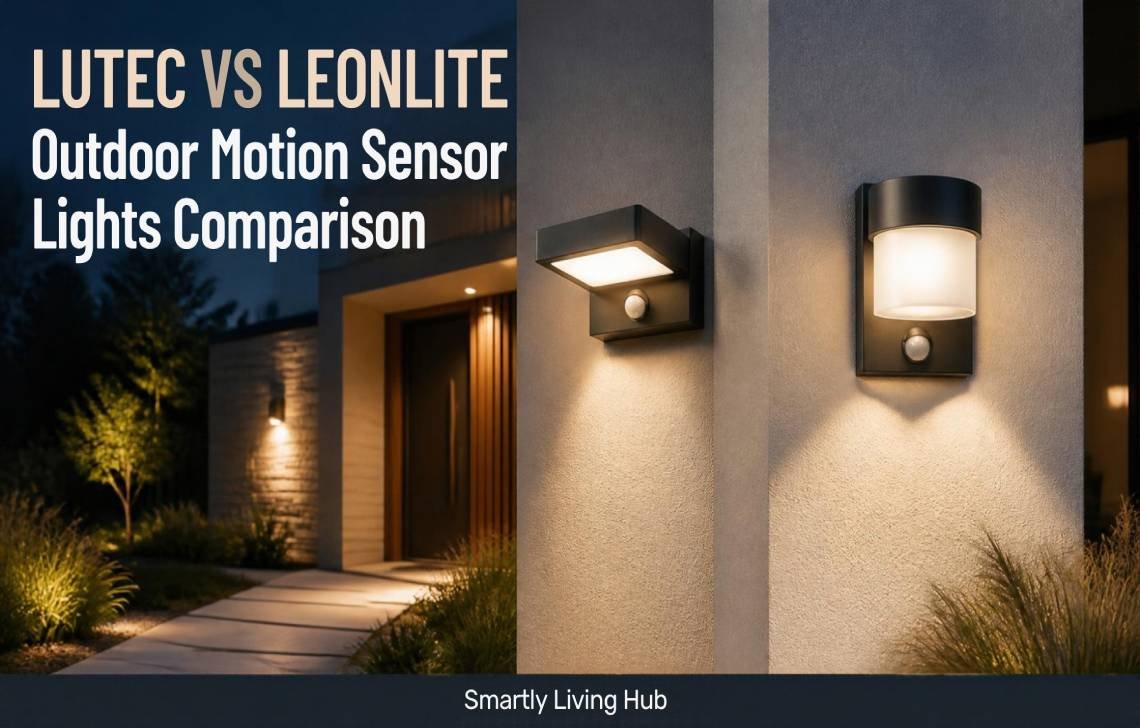
In the realm of home defense, shadows are the enemy. As a Senior Home Security Specialist, I have seen firsthand how a well-placed Motion Sensor can be the difference between a secure perimeter and a vulnerable one. However, the market for Outdoor Motion Sensor Lights has become increasingly crowded, leaving homeowners to choose between raw industrial power and streamlined residential convenience. Two names consistently rise to the top of the conversation: LUTEC and LEONLITE.
Choosing between LUTEC vs LEONLITE is not merely a matter of picking the highest lumen count; it is about understanding how light temperature, sensor sensitivity, and physical installation hardware interact with your specific property. Whether you are looking to illuminate a massive rural acreage or simply want a crisp, reliable light for your suburban two-car garage, the technical nuances of these units matter. In this comprehensive 2026 guide, we will break down the brightness capabilities, the precision of the sensing technology, and the real-world DIY challenges—from stripped screw posts to waterproofing gaskets—to help you decide which of these Outdoor Motion Sensor Lights deserves a spot on your eaves.
Side-by-Side Comparison Table
To begin our technical evaluation, we must look at the hard data. The following table compares the high-output LUTEC 72W model against the popular LEONLITE Security Flood Light.
Feature | LUTEC (72W/7500LM) | LEONLITE (Security Flood Light) |
Lumens/Brightness | 7,500 Lumens (Daylight White) | 1,400 Lumens (Crisp/Clear) |
Color Temperature | 5000K | Not Specified (High CRI profile) |
Wattage | 72W | ~15-20W (Estimated Efficiency) |
Detection Angle | Adjustable/Customizable | 180-Degree Wide Angle |
Max Detection Distance | Adjustable (High/Medium/Low) | 60 Feet |
Adjustability | 3 Individually Adjustable LED Heads | 2 Adjustable Dual Heads |
Key Accessories | Metal Mount, Gasket, Screw-Down Terminals | Base Plate, Cushioning Gasket, Mounting Screws |
Control Interface | Labeled Physical Switches | Standard Sensitivity Knobs |
Primary Use Case | Large Yards/Industrial Coverage | Driveways/Suburban Garages |
Feature Deep Dive: Brightness and Coverage
When analyzing Outdoor Motion Sensor Lights, the primary metric most homeowners fixate on is the lumen count. In the LUTEC vs LEONLITE standoff, we are looking at two very different philosophies of illumination.
The LUTEC is a powerhouse, boasting a massive 7,500-lumen output at a color temperature of 5000K. From a specialist’s perspective, 5000K is ideal for security because it mimics natural daylight, which improves the clarity of security camera footage and provides high contrast for the human eye. The three-head design of the LUTEC allows for a “wrap-around” lighting effect. You can angle the central head for long-range depth while angling the two side heads to cover blind spots or side walkways. This 72W unit is designed for those who need to “erase the night” across a large property.
On the other hand, the LEONLITE operates at 1,400 lumens. While this might seem modest compared to the LUTEC, it is a deliberate choice for residential environments. In a suburban neighborhood, 7,500 lumens can often lead to “light pollution,” triggering complaints from neighbors whose bedrooms are suddenly flooded with industrial-grade light every time a cat walks by. The LEONLITE provides a “bright and crisp” light that is perfectly balanced for a standard driveway. It provides enough visibility to safely park a car and deter intruders without overwhelming the immediate vicinity. Its 180-degree wide sensing angle is particularly impressive for its size, ensuring that movement coming from the sides of a garage is captured immediately by the Motion Sensor.
Performance and Sensor Precision
The most common failure point for Outdoor Motion Sensor Lights is not the bulb, but the sensor. A poor sensor leads to the “dance of the motion lights”—a phenomenon where one light triggers, and the reflected light or movement triggers another, creating a never-ending loop of flashing lights throughout the night.
Most outdoor motion sensor lights use Passive Infrared (PIR) sensors, which detect changes in infrared radiation caused by moving people, animals, or objects.
The LUTEC addresses this with a sophisticated, albeit intentionally “stiff,” sensor logic. On its lowest sensitivity setting, the LUTEC is described as “hilariously unresponsive.” While that might sound like a negative, it is actually a high-value feature for properties with high winds, moving bushes, or woodpile covers that flap in the breeze. By dialing in the sensitivity, you ensure the Motion Sensor only reacts to human-sized heat signatures at a reasonable range. The clearly labeled physical switches on the bottom of the LUTEC are a significant upgrade over the unlabeled, mysterious knobs found on older security units, allowing you to toggle between “Dusk to Dawn” mode (constant low light) and “Motion” mode with total clarity.
The LEONLITE takes a more traditional approach, optimized for immediate, high-sensitivity response within a 60-foot range. This is the “set it and forget it” option for homeowners who want their light to turn on the second a vehicle pulls into the driveway. While it lacks the granular “unresponsive” setting of the LUTEC, its wide 180-degree field of view makes it an excellent choice for corner-mounted installations where you need to monitor two different approaches simultaneously.
Installation and Setup: A DIY Perspective
As a technical reviewer, I pay close attention to the “ladder experience.” Installing Outdoor Motion Sensor Lights often involves dangling several feet in the air while managing small screws and wire nuts.
The LEONLITE Experience: The LEONLITE installation is remarkably efficient, often completed in under 20 minutes. It utilizes a base plate system that mounts directly to the electrical box. The kit includes two short screws for the sides and one long screw for the center of the floodlight. The wiring follows the standard “black to black, white to white” protocol. One technical detail to note is the “cushioning” or gasket that comes with the unit. This provides a basic level of weatherproofing, which is essential for eave-mounted lights above a garage. However, users should be careful to tuck the wires tightly into the box before tightening the central screw to avoid pinching the insulation.
The LUTEC Challenge: The LUTEC installation is more robust but comes with its own set of DIY hurdles. The unit includes a heavy-duty metal mount and, importantly, wire screw-down terminals rather than standard plastic wire nuts. These terminals provide a much more secure physical connection, though I recommend stripping off a bit more wire than usual to ensure a snug fit.
A critical warning for LUTEC users: the provided mounting screws are often too long for standard shallow light boxes. In my experience, using screws that are too long can puncture the wiring inside the box or prevent the light from sitting flush against the wall. If your screw posts are stripped—a common issue in older homes—the LUTEC plate can be mounted “the other way” (inverted) without affecting the light’s performance. Furthermore, never forget the gasket. The LUTEC relies heavily on its gasket for its waterproof rating; skipping this step means you will be climbing back up that ladder to disassemble the unit the first time it rains.
Ease of Use and Control Layouts
One of the greatest points of frustration with the LUTEC vs LEONLITE comparison involves the user interface. Most Outdoor Motion Sensor Lights hide their controls behind tiny, unlabeled dials that require a jeweler’s screwdriver to adjust.
LUTEC wins significant points here with its labeled switch system. The left switch handles distance and mode selection (including the highly useful “Test” mode), while the right switch manages the “Time On” duration. This eliminates the guesswork of standing on a ladder in the dark trying to remember which way is “more sensitive.”
Both brands offer excellent physical adjustability of the light heads. The LEONLITE heads are sturdy and hold their position well once tightened. The LUTEC, however, is superior for complex architecture. Its three-head design is “easily movable in many directions,” meaning you can point one head at the ground, one at the gate, and one at the side door, providing a truly customized security footprint that two-head models simply cannot match.
Pros and Cons: A Transparent Look
When deciding between LUTEC vs LEONLITE, you must weigh the technical trade-offs.
LUTEC Pros:
- Massive 7,500LM Output: Provides industrial-level brightness that eliminates all dark corners.
- Precision Sensitivity: The “unresponsive” low setting is a godsend for windy areas, effectively preventing false triggers.
- Superior Hardware: Includes a metal mounting plate and high-quality wire screw-down terminals for a professional-grade fit.
- Labeled Controls: No more guessing with unlabeled knobs; the switches are clear and intuitive.
LUTEC Cons:
- Calibration Time: You will likely spend 15+ minutes on a ladder experimenting with the sensor angle to get the trigger range just right.
- Screw Length Issues: The included hardware may require you to reuse old screws or find shorter alternatives to avoid pinching wires.
LEONLITE Pros:
- 20-Minute Setup: One of the fastest and most straightforward installations in the Motion Sensor category.
- Suburban Friendly: 1,400 lumens is bright enough for safety without being aggressive toward neighbors.
- 180-Degree Detection: Excellent wide-angle coverage that is perfect for garage eaves.
- Waterproof Reliability: Specifically designed to withstand the elements in exposed outdoor locations.
LEONLITE Cons:
- Lower Lumen Count: May feel underpowered for very large backyards or rural properties.
- Less Granular Control: Standard knobs are less precise than the LUTEC switch system, making it more prone to “nuisance” triggers from pets or bushes.
Best Use Cases: Which One Should You Buy?
Your choice between LUTEC vs LEONLITE should be dictated by your property’s acreage and environmental conditions.
Choose the LUTEC if: You have a significant amount of ground to cover, such as a large backyard, a long driveway, or a commercial storefront. If you live in a coastal or high-wind area where moving foliage frequently triggers cheap sensors, the LUTEC is the better investment. Its ability to be fine-tuned to ignore the “dance of the motion lights” makes it the professional’s choice for complex environments. It is the best Motion Sensor light for those who want maximum power and the ability to customize exactly when and where the light activates.
Choose the LEONLITE if: You are a suburban homeowner looking for a reliable, quick security upgrade. It is the ideal choice for a two-car garage or a side-door entry where you want “bright and crisp” light for daily tasks like taking out the trash or parking the car. If you are a DIY novice, the LEONLITE‘s simple three-screw installation is much more forgiving than the LUTEC. It is a streamlined, efficient, and effective Outdoor Motion Sensor Lights solution for the average residential lot.
Final Verdict
After a thorough technical evaluation of LUTEC vs LEONLITE, the winner depends on your priority: Raw Power vs. Simple Reliability.
The LUTEC is the heavyweight champion of Outdoor Motion Sensor Lights. With 7,500 lumens and a sophisticated sensor that can be tuned to ignore environmental noise, it offers a level of control that is rare at its price point. It is a “pro-sumer” tool that requires a bit more patience during installation but rewards the user with industrial-grade security.
The LEONLITE is the king of residential convenience. It provides a crisp, daylight-white light that is perfect for the average home. Its 180-degree Motion Sensor provides excellent coverage for driveways, and its 20-minute installation makes it accessible to anyone with a screwdriver and a ladder.
Assess your property’s acreage and your neighbors’ proximity before committing. If you need to light up a field, buy the LUTEC. If you need to light up a garage, buy the LEONLITE. Either way, you are taking a significant step toward a safer, more secure home.
FAQs
How many lumens do I need for an outdoor security light?
In most suburban settings, 1,400 to 2,500 lumens is the “sweet spot” for providing security without causing light pollution issues for neighbors. However, for large properties or areas with no ambient street lighting, a 7,500-lumen unit like the LUTEC is necessary to ensure no “dark zones” remain where intruders can hide.
Is the LUTEC vs LEONLITE installation hard for beginners?
Neither is considered “hard,” but the LEONLITE is more beginner-friendly due to its 20-minute setup and standard screw compatibility. The LUTEC requires more attention to detail regarding screw length and the proper seating of the waterproof gasket, which can be tricky for those who aren’t comfortable “dangling on a ladder” for extended periods.
Can I adjust the motion sensitivity on these lights?
Yes. Both allow for adjustment, but they do it differently. The LEONLITE uses standard knobs to reach a 60-foot max distance. The LUTEC uses labeled switches that offer more granular control, including a low-sensitivity mode specifically designed to ignore moving plants and wind.