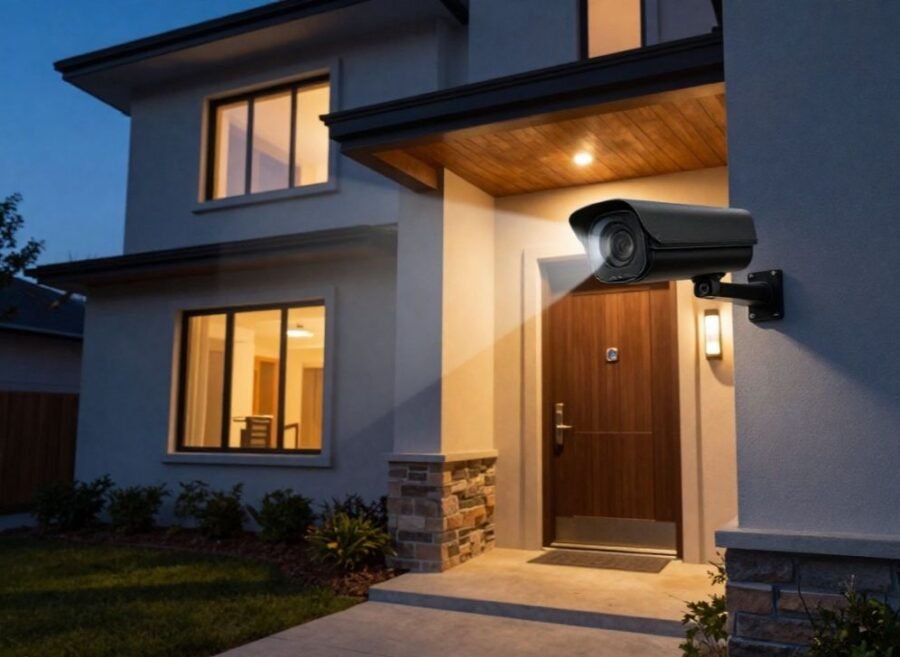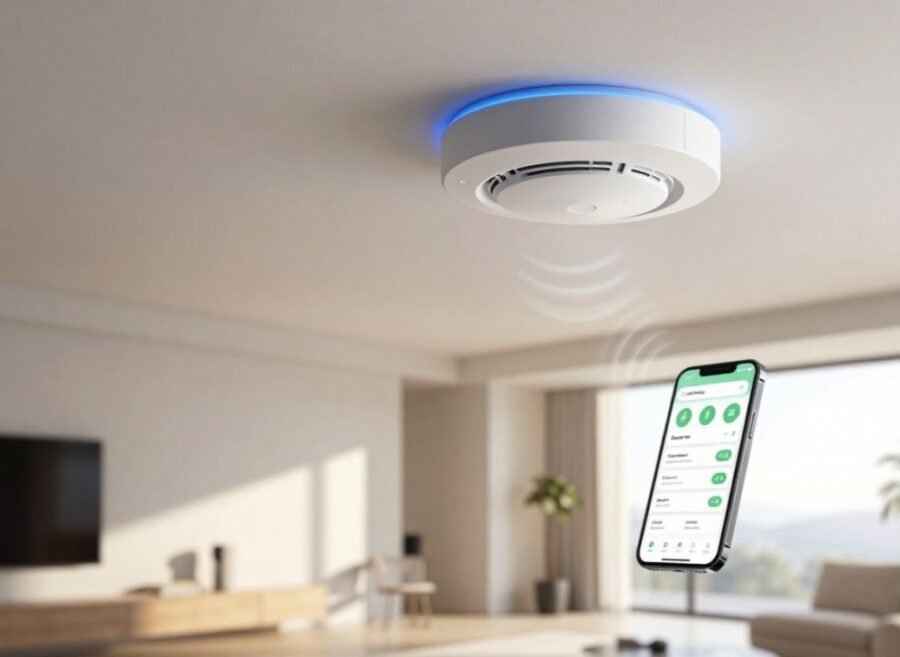

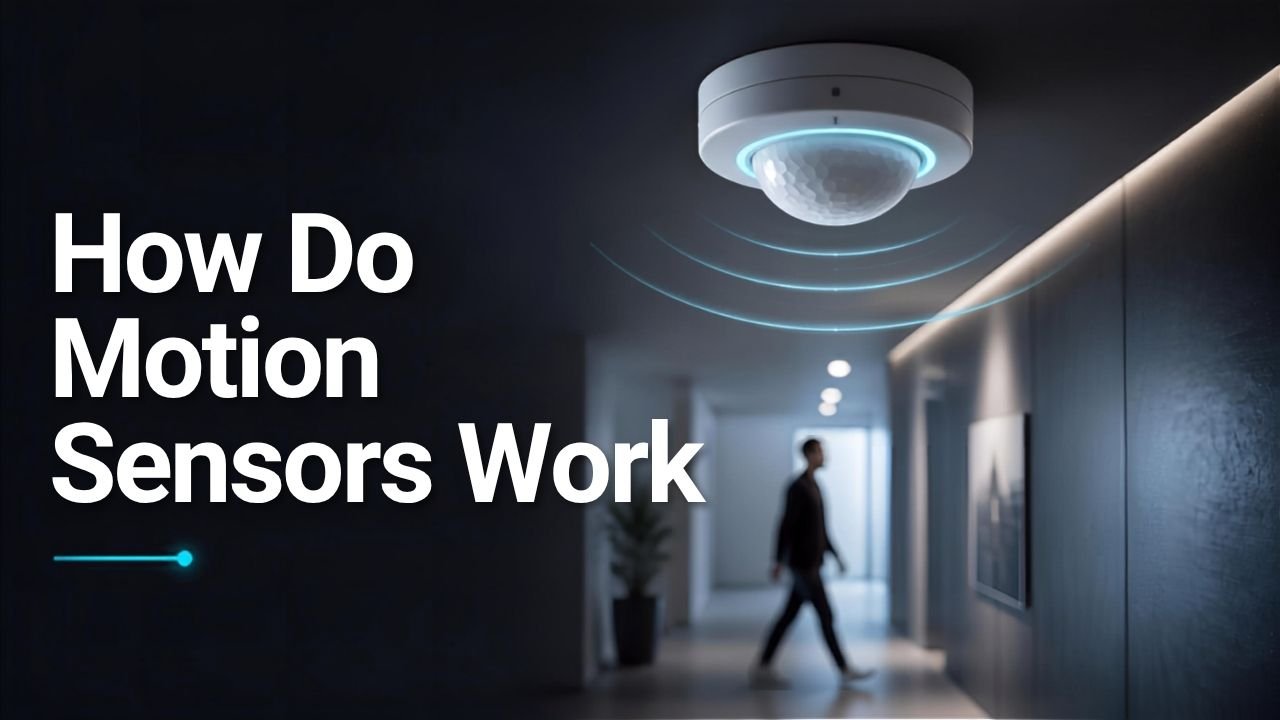
Motion sensors work by monitoring a specific environment for changes in energy, heat, or waves. When a person or object enters the sensor’s “field of view,” the device detects a disruption—such as a shift in infrared radiation or a change in wave reflection—and sends a signal to a processor to trigger an action.
The most common technologies used in motion detection include:
- Passive Infrared (PIR): Detects changes in body heat.
- Microwave (MW): Uses radio wave reflections to measure distance and movement.
- Ultrasonic: Emits high-frequency sound waves to detect echoes.
- Dual-Technology: Combines PIR and Microwave for higher accuracy.
Motion sensors serve the Three Pillars of Purpose: Security (detecting intruders), Automation (hands-free lighting and HVAC control), and Energy Efficiency (reducing utility waste). Today, they are essential components in smart homes, commercial offices, and industrial facilities.
What Is a Motion Sensor?
At its core, a motion sensor is a digital sentry that monitors a “field of view” for physical displacement. To provide reliable detection, almost every unit consists of three primary components:
- The Sensor: The hardware that receives environmental input (heat, sound, or radio pulses).
- The Processor: The “brain” that interprets the signal. It uses specific logic to determine if the input represents a true human presence or just background noise.
- The Output Signal: The final command that triggers a response, such as a siren, a smartphone notification, or a light activation.

The Mechanics: How Motion is Detected and Processed
Motion detection is a continuous cycle of environmental monitoring. The sensor establishes a “baseline”—a picture of the room under normal, still conditions. When an object enters the field, it creates a disruption.
For a sensor to trigger, the change must be significant enough to pass a pre-set threshold. Once the processor confirms the movement, it sends the output signal. This chain of events happens in milliseconds, allowing for near-instant responses like a camera beginning to record the moment a door opens.
Deep Dive: Types of Motion Sensors
Passive Infrared (PIR) Sensors
Passive Infrared (PIR) sensors are the standard for residential security. They are “passive” because they do not emit energy; instead, they sit back and “listen” for infrared energy (body heat).
Inside the unit, a pyroelectric sensor contains two or more photoactive diode areas. These use differential pulse logic: one area monitors the ambient temperature of the room, while the other looks for changes. A “motion” signal is only generated when there is a significant difference between what these two areas see.
- Expert Note: PIR sensors cannot see through walls or glass, as these materials block infrared radiation.
Microwave (MW) Sensors
Microwave (MW) sensors are “active” units that constantly emit pulses of radio waves. These waves bounce off objects and return to the sensor. The device measures the reflection rate to calculate the distance of objects in the room. If an object moves, the reflection rate changes, indicating that the distance between the sensor and the object has shifted. While they cover larger areas than PIR, they can sometimes “see” through thin walls, leading to false alarms from neighboring rooms.
Ultrasonic Sensors
These active sensors use high-frequency sound waves—beyond the range of human hearing—to scan a room. They detect movement by measuring the “echo” or reflection of these sound waves. They are highly effective for indoor environments but can be sensitive to rapid air movement.
Dual-Technology Sensors
To virtually eliminate false alarms, Dual-Technology sensors combine PIR and Microwave tech into one housing. For the alarm to trigger, both sensors must detect movement simultaneously. This ensures that a sudden gust of warm air (triggering the PIR) or a moving curtain (triggering the Microwave) doesn’t cause a false alert.
Specialized & Emerging Sensors
- Tomographic Sensors: These consist of multiple nodes that create a mesh of radio waves. They can be completely hidden behind artwork or inside walls because they do not require a line of sight. They are unique because they can accurately detect motion through walls and furniture.
- Vibration Sensors: These detect the minute seismic tremors caused by footsteps or a heavy object moving across a floor.
- Area Reflective Sensors: Often confused with PIR, these are actually Active Infrared devices. They emit their own pulses of infrared light and measure the speed at which that light reflects off objects to detect presence.
Key Anatomy of a Motion Sensor Unit
- Sensor Unit: The internal hardware (PIR, Microwave, etc.) that receives the environmental data.
- Fresnel Lens: This is the plastic, multi-faceted cover on most sensors. It works by bending and focusing infrared light into the sensor’s diode areas. This creates “zones” of detection, which allow the sensor to distinguish between a human walking and a small pet on the floor.
- Control Circuitry: Manages the sensitivity settings and communication with your security hub.
- Power Source: Options include long-life batteries (often lasting 1–2 years) or hard-wired connections for permanent installations.
Practical Applications: From Security to Smart Living
- Home Security: Intrusian detection, professional monitoring triggers, and automatic video recording.
- Smart Automation: Hands-free lighting in hallways and “welcome home” scenes that activate when you walk through the front door.
- Resource Management & Building Intelligence: In commercial settings, sensors provide data on space utilization. Managers can identify under-utilized offices or meeting rooms and adjust HVAC and cleaning schedules to save costs.
- Family & Pet Care: Monitoring if a toddler leaves their bed, tracking teenagers coming home late, or triggering automatic pet doors.
Advantages and Limitations
Advantages | Limitations |
Enhanced security and instant alerts | False alarms from pets, insects, or rapid air shifts |
Hands-free convenience and automation | Range limits (typically ~80 feet for residential) |
Significant energy savings via HVAC/Lighting | PIR units are blocked by walls and furniture |
Remote monitoring via smartphone apps | Sensitivity to sunlight glare or heat vents |
Technical Guide: Installation & Maintenance
Optimal Placement
For the best coverage, mount your sensors 66 to 78 inches high. Placing them in corners or opposite primary entry points (like the front door) ensures an intruder must walk across the sensor’s path, which is where they are most sensitive.
Mounting Options
- Magnetic Mount: Increasingly popular for DIY systems, these allow you to snap the sensor onto a bracket and rotate it to the perfect angle. These are ideal for freestanding placement on shelves or “peel-and-stick” wall mounting.
- Screw Mount: The traditional method for permanent installations. This involves drilling a 7/32″ hole, inserting an anchor, and securing the bracket flush to the wall.
Pro Tip: Keep PIR sensors 10–15 feet away from radiators, heating vents, or windows. Rapid temperature changes from a furnace kicking on or a sunbeam hitting the lens can create a “differential pulse” that looks like a human to the processor, triggering a false alarm.
Critical Maintenance
- Clean the Lens: Dust blocks infrared light and sound waves. Wipe the lens with a dry, clean cloth every two months.
- Never Paint the Lens: Painting over the sensor—even with thin paint—will render it completely blind.
- Annual Battery Checks: Replace batteries annually for wireless units to ensure they never go offline during an emergency.
FAQs
Can my dog trigger my motion detector?
Many modern sensors feature “Pet Immunity.” You can often toggle between a “Light” mode (for pets under 20 lbs) and a “Heavy” mode (for pets up to 60–85 lbs). The Fresnel lens is designed to ignore motion at the floor level to accommodate four-legged friends.
Can you trick a motion sensor?
While you can attempt to move extremely slowly or mask your heat signature, these methods are rarely successful. Modern processors are designed to detect even minute shifts in energy, and human movement is difficult to mask with 100% precision.
Can light set off a sensor?
Yes. Rapid changes in light—like a car’s headlights hitting a window or a sudden sunburst—can shift the electromagnetic spectrum enough to register as a temperature change on a PIR sensor.
How many sensors do I need?
Most residential sensors have a range of about 80 feet. For a standard home, three sensors (placed at the front entry, back entry, and a central hallway) are usually sufficient.
Can sensors see through walls?
PIR sensors cannot. However, tomographic sensors use radio waves that penetrate walls, allowing them to monitor rooms from a completely hidden position.