

Yes, modern robot vacuums work exceptionally well on carpets, with flagship models now bridging the gap between daily maintenance and deep cleaning. Thanks to a massive leap in hardware, today’s top-tier robots feature suction power up to 35,000Pa and can clear obstacles as high as 3.47 inches, effectively ending the era where robots were restricted to low-pile rugs. While a traditional vacuum is still recommended for quarterly deep-tissue fiber extraction, a high-spec robot handles 95% of carpet maintenance, including embedded pet hair and fine allergens. So, do robot vacuums work on carpet? For most modern homes, the answer is yes, especially when the robot has strong suction, effective brush agitation, and automatic carpet detection.
How Well Do Robot Vacuums Clean Carpet?
As a specialist who has tested everything from early “bump-and-go” models to today’s AI-driven flagships, I can tell you that carpet performance is no longer a monolith. It is determined by three specific technical pillars:
- Extraction Power: Surface-level dust is easy, but pulling grit from the base of a carpet requires high static pressure. While mid-range models offer 5,000Pa, premium units like the Dreame L60 Pro Ultra reach 35,000Pa, providing enough “lift” to rival some corded stick vacuums.
- Mechanical Agitation: Suction alone won’t work on fibers. You need advanced brush rolls—like the TangleCut 2.0 or DuoSpiral systems—that vibrate and “comb” the pile to release trapped debris.
- Debris Management: Carpet generates significantly more lint and fiber-bound dust than hard floors. High-end systems now include self-emptying docks with medical-grade filtration to manage this increased volume.
Carpet Type Compatibility: What Can Your Robot Handle?
The “pile” or thickness of your carpet dictates which robot you should buy. Using the wrong settings on a delicate rug can lead to fiber damage, while a low-powered robot will simply stall on plush surfaces.
Low-Pile Carpet (Cotton, Synthetic, Office)
These are the ideal “gym floors” for robots. Almost any modern model can navigate these with ease, requiring only standard suction settings.
Medium-Pile Carpet (Standard Wall-to-Wall)
The most common household surface. Success here requires “Carpet Boost” technology, which detects the change in floor type and automatically ramps up suction to maximum levels.
High-Pile and Plush Carpet
Historically a “no-go” zone, these are now manageable for robots with high-clearance wheel modules. The Dreame X60 Ultra, for instance, features a 3.47-inch (88mm) crossing height, allowing it to climb onto thick rugs that would have high-centered older machines.
Specialized and Delicate Rugs
- Silk Rugs: These require extreme care. Use soft bristle brushes, lower suction settings, and set virtual barriers in the app to prevent high-intensity cleaning.
- Hair-on-Hide (Cowhide/Sheepskin): These unique textures are vulnerable to rotating brushes. Set your robot to “Gentle Suction” and “No-Brush” mode to prevent pulling the hair from the hide.
- Natural Fiber (Sisal, Jute, Seagrass): These are durable but uneven. Most automatic vacuums handle them well, though the uneven surface may trigger obstacle sensors on lower-end models.
Carpet Compatibility Summary
Pile Type | Success Rate | Key Technical Requirement |
Low-Pile | High | Standard 5,000Pa Suction |
Medium-Pile | High | Carpet Boost & Agitating Brushes |
High-Pile | Moderate to High | >20,000Pa Suction & 3.47in Climbing Height |
Shag/Ultra-Long | Variable | "Bypass Mode" recommended for navigation |
Silk/Hide | Specialized | No-Brush Mode / Soft Bristles |
Navigating Area Rugs: Challenges and Solutions
Area rugs present unique physics challenges, from bunching to “cliff” sensor errors. Dark-colored or black rugs often trick older infrared sensors into thinking the robot is at the edge of a staircase, causing it to stop.
Pro-Tech Solution: Look for models like the ECOVACS DEEBOT X9 PRO OMNI, which uses ultrasonic sensors and 3D Structured Light to distinguish between a dark rug and a “cliff,” ensuring it cleans your black rugs without hesitation.
What Makes a Robot Vacuum "Good" for Carpet?
If you are shopping for the best robot vacuum for a carpet-heavy home, these are the non-negotiable specs:
- Ultra-High Suction: Don’t settle for “standard.” Target the 20,000Pa to 35,000Pa range found in the Dreame L60 Pro or eufy Omni E28 for deep-fiber extraction.
- Obstacle Clearing (Climbing): Ignore the old 0.79-inch (20mm) limit. Flagship models like the Dreame Matrix10 Pro can now clear 3.15-inch obstacles, and the X60 Ultra handles up to 3.47 inches.
- Tangle-Free Brush Technology: Look for the TriCut Brush or TangleCut 2.0 systems. these use hidden blades or specialized geometry to shear hair before it wraps around the roller, a common fail point on carpet.
Floor Transitions and Navigation
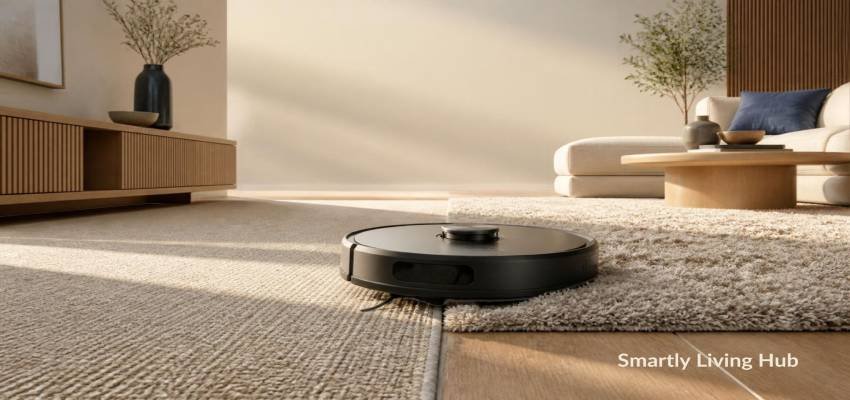
Moving from hardwood to carpet requires a “physical climb.” If your transition thresholds are high, a standard robot will simply bounce off the rug like it’s a wall. The latest generation of “Active Climbing” robots use high-torque motors and larger wheel diameter to handle heights up to 3.47 inches, making them compatible with even the thickest plush rugs and high room thresholds.
Managing Pet Hair on Carpeted Surfaces
Pet hair weaves into carpet fibers, making it significantly harder to remove than on tile. Do robot vacuums work on carpet when you have pets? Yes, but performance depends heavily on brush design, suction power, and how frequently the robot runs. To combat this, I recommend running the vacuum daily. This prevents the hair from “nesting” deep in the pile. Technology like eufy’s DuoSpiral Detangle Brushes is specifically engineered to agitate the hair upward into the suction stream without clogging.
The Mopping Dilemma: Can You Mop Carpet?
You should never mop a carpet, as moisture leads to mold and fiber degradation. If you prefer a dedicated vacuum for carpet rather than a vacuum-and-mop combination, see our guide to the best robot vacuum without a mop.
- Auto-Lift Technology: Robots like the Dreame D30 Ultra can now lift their mopping pads 0.41 inches (10.5mm) off the ground the moment carpet is detected.
- Bypass Mode: For ultra-long haired carpets where 10.5mm isn’t enough clearance, the “Bypass” mode (found in ECOVACS systems) instructs the robot to completely avoid carpeted zones until the mopping pads are removed.
Pros and Cons: A Quick Comparison
Pros | Cons |
Automated Upkeep: Maintains "fresh vacuumed" look daily. | Battery Drain: High-power carpet modes drain battery 30% faster. |
Allergen Control: Frequent passes reduce dander and dust. | Fringe Hazards: Tassels can still tangle in high-torque brushes. |
Obstacle Mastery: New 3.47in clearing limits handle thick rugs. | Bin Capacity: Carpet lint fills bins faster than hard floor dust. |
Hybrid Power: High Pa ratings (35k) rival traditional vacuums. | Initial Cost: Deep-cleaning carpet tech is found in premium models. |
Pro-Tips: Getting Better Results on Carpet
- Enable “Carpet Prioritized Cleaning”: Some models now allow you to clean carpets first while the mop is dry, preventing cross-contamination from wet hard floors.
- Tuck Your Fringes: Even with “tangle-free” tech, long tassels are a hazard. Tuck them or set “No-Go Zones.”
- Clean Sensors Weekly: Dust from carpet fibers can coat the “Cliff” and “Carpet Detection” sensors. A quick wipe with a microfiber cloth keeps navigation sharp.
- Use “Multi-Pass” Modes: For high-traffic areas, set the app to perform two perpendicular passes (X-pattern) to ensure agitation from all angles.
Do You Still Need a Traditional Vacuum?
Historically, the answer was a resounding yes. Today, it’s a “maybe.” If you own a model like the eufy Omni E28, it actually includes a “FlexiOne” portable deep cleaner integrated into the station. This gives you a handheld/stick option for stairs and upholstery, effectively replacing the traditional vacuum entirely. However, for homes without a hybrid solution, a manual deep-clean once a month is still the gold standard for long-term carpet health.
Final Verdict
If your home is carpeted, a robot vacuum is no longer just a luxury—it’s the most effective way to prevent the buildup of allergens and grit. The “old rules” of robots getting stuck or lacking power have been erased by the current generation of 35,000Pa machines with 3-inch+ climbing capabilities. Match the robot to your pile type, enable “Carpet Boost,” and let automation do the heavy lifting.
FAQs
Do robot vacuums work on thick/shag carpet?
Modern high-end models can handle heights up to 3.47 inches. However, shag carpet remains a tangle risk; always check if your robot has a “No-Brush” mode if the shag is particularly loose.
Can a robot vacuum damage my carpet?
No, but delicate rugs like Silk or Wool should be cleaned with “Gentle Suction” and soft brushes. Avoid aggressive agitation on high-value Persian rugs.
Do they work on black or dark rugs?
Yes, if you choose a model with LiDAR or 3D ToF (Time of Flight) sensors. These don’t rely on infrared light, so they aren’t “blinded” by dark colors.
How often should I run it on carpet?
Daily. Because carpets trap debris, frequent maintenance prevents dirt from being crushed into the backing of the carpet by foot traffic.