
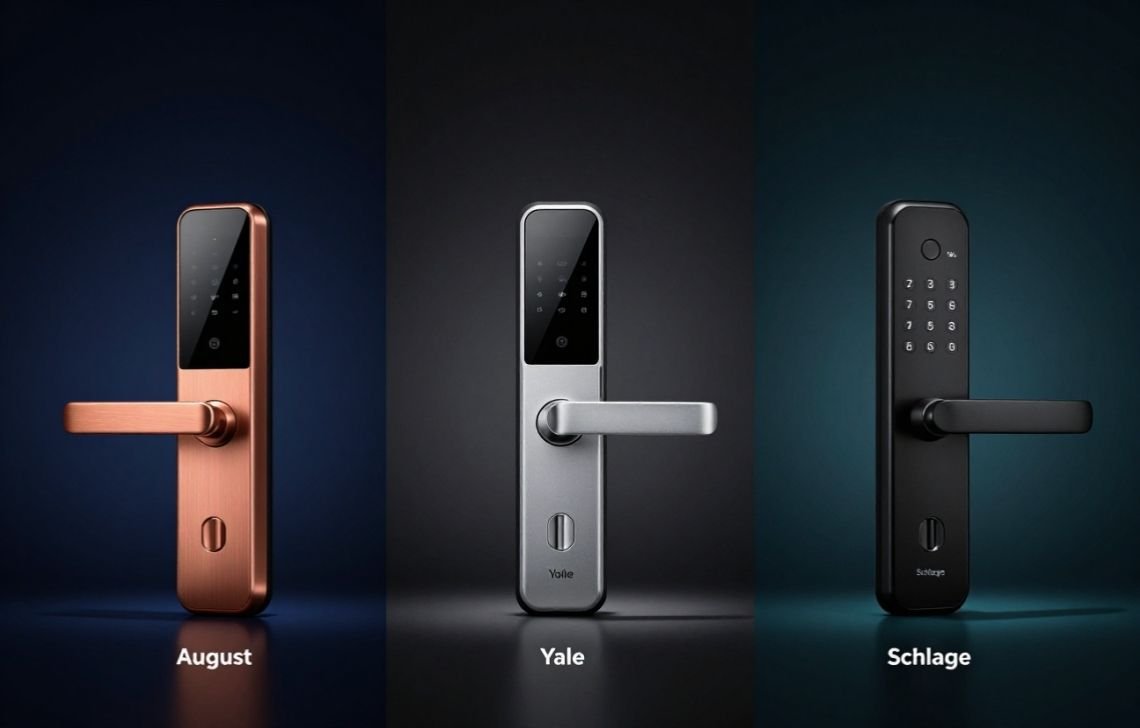
For homeowners and renters in 2026, the front door is the primary gateway to a connected life. However, choosing a smart lock remains one of the most polarizing decisions in home automation. You are essentially trying to balance three competing forces: the high-tech convenience of hands-free entry, the physical robustness required to stop a forced entry, and the technical compatibility of your existing smart home ecosystem.
As a specialist in residential IoT, I often see consumers fall into the trap of buying a lock based on aesthetics alone, only to find it doesn’t support their phone’s native “tap-to-unlock” features or, worse, lacks the physical hardware to withstand a basic breach. In this comparison of August vs Yale vs Schlage: Best Smart Lock Brand, we are going to look past the marketing gloss and dive into the hardware grades, encryption standards, and real-world battery performance that define these industry leaders.
Whether you are looking for a non-destructive retrofit for an apartment or a commercial-grade deadbolt for your primary residence, this guide will break down the technical nuances that matter.
What You’ll Learn:
- Hardware Integrity: A deep dive into ANSI Grade 1 vs. Grade 2 ratings and what 800 lbs of force resistance actually looks like.
- Installation Architecture: Comparing 10-minute retrofit modules like August to full-deadbolt replacements like the Schlage Encode and Yale Assure.
- Smart Features & Ecosystems: The mechanics of Apple Home Key, DoorSense magnetic tracking, and modular connectivity.
- Security Standards: Understanding 128-bit AES encryption and two-factor authentication (2FA) in the context of your front door.
At-a-Glance Comparison Table
Feature | August (4th Gen Wi-Fi) | Yale (Assure Lock 2 / Plus) | Schlage (Encode / Encode Plus) |
Installation Type | Retrofit (Interior Only) | Full Deadbolt Replacement | Full Deadbolt Replacement |
Security Rating | ANSI Grade 2 (Hardware dependent) | ANSI Grade 2 | ANSI Grade 1 / AAA (Highest) |
Physical Strength | Varies by existing bolt | 5 Hits / 250 lbs Force | 6 Hits / 800 lbs Force |
Connectivity | Built-in Wi-Fi & Bluetooth | Modular (Wi-Fi, Z-Wave, Matter) | Built-in Wi-Fi |
Apple Home Key | No | Yes (Plus Model Only) | Yes (Encode Plus Only) |
Biometrics | No | Yes (Touch Model Only) | No |
Built-in Alarm | No | No | |
Encryption | 128-bit AES | 128-bit AES | 128-bit AES |
Max Access Codes | Virtual Keys (via App) | 100+ Unique Codes | 100+ Unique Codes |
Typical Price | $180 – $200 | $150 – $290 | $230 – $300 |
August Smart Locks: The King of Retrofit
The Big Picture
August has maintained its dominance by solving a very specific problem: how to add smart functionality without touching the exterior of the door. The August Wi-Fi Smart Lock (4th Gen) is a “retrofit” solution, meaning it only replaces the interior thumb-turn of your existing deadbolt. This is a game-changer for those who want to keep their current keys or reside in a property where changing the exterior hardware is prohibited.
Detailed Strengths
The standout technical feature for August is DoorSense™. Unlike most locks that only know if the bolt is extended, August uses a magnetic sensor mounted to the door frame. This allows the lock to distinguish between a door that is “locked” and one that is “locked but standing wide open.”
From a software perspective, August offers arguably the best geofencing in the business. Its Auto-Unlock feature uses your phone’s GPS and Bluetooth to detect when you are arriving home, triggering the unlock as you walk up the path. For security, August utilizes bank-level 128-bit AES encryption and two-factor authentication, ensuring that your digital “key” is as safe as your banking app.
The Trade-offs
The convenience of retrofit hardware comes with a mechanical cost. Because the August motor has to turn your existing (and often unaligned) deadbolt, it requires significant torque. This results in the shortest battery life of the group—typically around three months on two CR123 batteries.
Specialist Insight: I always recommend keeping a set of CR123s in a junk drawer. Because the August motor fights against any friction in your existing door alignment, the battery drain can be unpredictable if your door isn’t perfectly plumb.
Furthermore, while the hardware is Grade 2 equivalent, your actual security is limited by the quality of the deadbolt you already have. If your existing lock is a $10 bargain-bin bolt, August won’t make it physically stronger.
Pros & Cons
- Pros:
- No change to exterior appearance or keys.
- 10-minute installation (no new holes).
- Best-in-class geofencing and app UI.
- DoorSense magnetic status tracking.
- Cons:
- Shortest battery life (3 months).
- No Apple Home Key support.
- Keypad is a separate 60–80 purchase.
- Requires a compatible existing deadbolt.
Yale Smart Locks: Modular Versatility & Style
The Big Picture
Yale’s Assure Lock 2 series is the “Swiss Army Knife” of smart locks. Yale’s philosophy centers on modularity; the lock features a “Smart Module” slot behind the battery cover. This allows you to swap connectivity modules (Wi-Fi, Z-Wave, or Matter) as your smart home evolves, preventing the hardware from becoming obsolete.
Detailed Strengths
For Apple users, the Yale Assure Lock 2 Plus is a top contender because it supports Apple Home Key. This allows you to tap your iPhone or Apple Watch against the lock to enter, even if your phone’s battery has technically “died” (via Power Reserve mode). Yale also excels in entry variety; you can choose between a sleek touchscreen, physical tactile buttons, or a fingerprint-enabled model.
Yale also provides a critical safety feature: the 9V Battery Backup. If your internal 4 AA batteries die completely, you can hold a standard 9V battery to the terminals at the bottom of the lock to provide enough temporary juice to enter your code and get inside.
The Trade-offs
A vital distinction for buyers: The Yale Touch (fingerprint) and Yale Plus (Home Key) are separate models. You cannot currently get a Yale lock that offers both biometrics and Apple Home Key in one unit. Furthermore, Yale locks are ANSI Grade 2. While this is perfectly suitable for most residential applications, they lack the extreme force resistance of Schlage’s Grade 1 units. The Wi-Fi modules are also known to be power-hungry, sometimes draining batteries in as little as 6 to 8 weeks.
Pro Tip: If you want the Yale ecosystem but need a retrofit installation similar to August, look for the Yale Approach. It offers the same interior-only mounting but integrates with Yale’s keypad and app environment.
Pros & Cons
- Pros:
- Modular connectivity (Matter-ready).
- Apple Home Key support (Plus model).
- Tactile or touchscreen options.
- 9V emergency power terminal.
- Cons:
- Grade 2 security rating.
- Home Key and Fingerprint are mutually exclusive.
- Louder motor operation.
- Significant battery drain on Wi-Fi models.
Schlage Smart Locks: Commercial-Grade Security
The Big Picture
If your primary concern is stopping a motivated intruder, Schlage is the definitive answer. With over 100 years in the industry, Schlage builds their smart locks—specifically the Encode and Encode Plus—on a foundation of commercial-grade metal hardware.
Detailed Strengths
The Schlage Encode Plus is ANSI/BHMA Grade 1 (AAA) certified. To earn this, the lock must withstand 800 lbs of vertical force and 450 lbs of lateral force (the equivalent of multiple heavy sledgehammer blows or kicks). Most smart locks on the market will fail long before reaching these numbers.
Schlage also integrates a built-in 85 dB tamper alarm. This sensor detects forced entry attempts or significant vibration on the door and emits a piercing alert to deter the intruder immediately. For accessibility, the Encode series features large, ADA-compliant buttons that are easy to use for the elderly or those with limited dexterity.
Installation is also surprisingly easy thanks to the “Snap ‘n Stay” design. This feature holds the deadbolt in place against the door without you needing three hands to hold the interior and exterior pieces together while you find the screws.
The Trade-offs
Schlage is not a subtle lock. The exterior housing is bulkier than the sleek Yale or the invisible August. It also lacks “Auto-Unlock” geofencing; Schlage prioritizes security over the potential risk of a door unlocking accidentally while you are just moving around inside your house. Finally, the Encode Plus is required for HomeKit/Apple Home Key; the standard Encode only supports Alexa and Google Home.
Pros & Cons
- Pros:
- Highest security rating (Grade 1/AAA).
- Withstands 800 lbs of force.
- Built-in 85 dB tamper alarm.
- Physical backup key on all models.
- Superior battery life (6+ months).
- Cons:
- No geofencing/auto-unlock.
- Bulkier exterior footprint.
- Highest price point in the segment.
- Standard Encode lacks HomeKit entirely.
Feature-by-Feature Showdown
Security & Build Quality
This is where Schlage pulls ahead. While all three brands utilize 128-bit AES encryption for their digital signals, the physical hardware varies wildly. Schlage’s Grade 1 rating means it can survive 6 forced-entry attempts, whereas the Grade 2 ratings of Yale and August are tested for only 2 attempts. The inclusion of the tamper alarm in the Schlage Encode makes it the only lock in this trio that actively fights back against physical intervention.
Installation & Door Fit
August wins for speed (10 minutes) and is the only “renter-friendly” option that doesn’t involve re-keying. Schlage wins for DIY design with the “Snap ‘n Stay” feature. Yale falls in the middle; it requires a full replacement and precise alignment, but their “all-metal housing” feels more substantial than many budget competitors during the install process.
Smart Ecosystems
- Apple Users: It is a tie between the Yale Assure Lock 2 Plus and Schlage Encode Plus. Both support Apple Home Key. August does not support Home Key, only standard HomeKit app control.
- Google/Alexa Users: All three brands perform excellently here, though August’s app is generally regarded as the most intuitive for managing guest access and viewing activity logs.
Battery Life & Power Backups
Schlage is the winner for longevity, consistently hitting the 6-month mark on 4 AA batteries. Yale offers the best “emergency” solution with the 9V terminal, preventing a lockout if you ignore the low-battery warnings. August is the “high maintenance” child of the group; between the power-hungry motor and the CR123 batteries, you will be changing power sources four times as often as you would with a Schlage.
Which is Best for You?
Best for Renters: August
August is the only responsible choice for apartment dwellers. Since it only modifies the interior thumb-turn, you can revert the door to its original state in minutes when your lease ends, and your landlord never has to worry about lost keys or modified exterior aesthetics.
Best for Security-First Homeowners: Schlage
If you are securing a primary residence, especially one with a street-facing front door, the Schlage Encode Plus is the gold standard. Its Grade 1 rating and built-in alarm provide a level of physical deterrent that the other two simply cannot match.
Best for Apple Power Users: Yale Assure 2 Plus
While both Schlage and Yale offer Home Key, the Yale Assure 2 Plus feels more “tech-forward” with its modular connectivity and sleeker design. If you want a lock that feels like a piece of modern hardware and lives in the Apple ecosystem, this is it.
Best for Airbnb/Short-Term Rentals: Yale or Schlage
Never use a lock that requires guests to download an app. Both Yale and Schlage feature integrated keypads and support up to 100+ unique codes. You can set codes to expire automatically at checkout time, and Schlage even offers direct integration with the Airbnb platform for automated code generation.
Final Verdict
There is no “perfect” lock, only the lock that is perfect for your specific door.
- Choose August if you are a renter, a minimalist, or someone who values the “magic” of geofencing auto-unlock above all else. It is the king of convenience.
- Choose Yale if you want the most entry options (fingerprint vs. keypad vs. Home Key) and want a lock that is future-proofed through modular upgrades.
- Choose Schlage if you want a “tank” on your door. Its commercial-grade hardware and built-in alarm make it the superior choice for high-security residential needs.
FAQs
Which smart lock is best for renters?
The August Wi-Fi Smart Lock is the best for renters because it is a retrofit adapter. It installs on the inside of the door, keeping the original exterior hardware and keys intact.
Do I need a hub for these locks?
The August 4th Gen and Schlage Encode series have Wi-Fi built-in and do not require a hub. Yale models vary; some come with Wi-Fi modules, while others require a separate bridge or hub for remote access.
What is the difference between ANSI Grade 1 and Grade 2?
ANSI Grade 1 is the highest residential security rating. It must withstand 800 lbs of force and 6 forced-entry attempts. Grade 2 is the standard residential rating, tested for 250 lbs of force and 2 forced-entry attempts.
Can I still use my physical key with these locks?
With August, yes—you keep your original key. Schlage Encode models all include a physical keyway. Yale offers “Key-Free” models for maximum security against lock-picking, but provides a 9V battery terminal for emergency power.
Which lock has the best battery life?
Schlage typically lasts 6+ months on 4 AA batteries. August has the shortest life (3 months) due to the high-torque motor required for retrofit installations.