
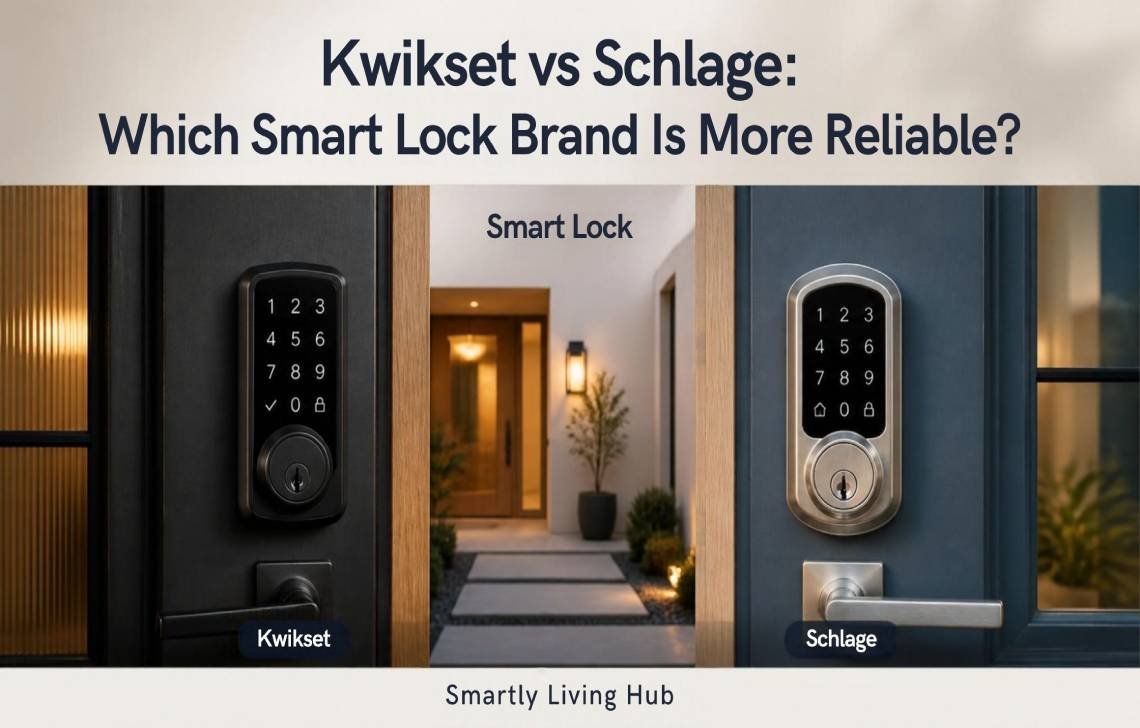
For residential and commercial security consultants, the debate over Kwikset vs Schlage is more than just a matter of brand preference; it is a fundamental decision regarding facility management, life-safety compliance, and long-term operational costs. These two industry giants dominate the North American market, yet they serve distinct operational philosophies. Selecting the Best Smart Lock for a property requires a deep dive into mechanical duty cycles, electronic ecosystem compatibility, and key-control hierarchies.
This guide provides an expert-level comparison of Kwikset vs Schlage, analyzing their performance across ANSI/BHMA security grades, 2026 technology standards like Matter and Apple Home Key, and total lifecycle value. Whether you are managing a 400-unit multifamily development or a high-traffic commercial corridor, the hardware on your door is your first line of defense in maintaining robust Home Security.
Quick Answer: Schlage is the definitive choice for high-use commercial, institutional, and premium residential openings requiring Grade 1 durability and structured keying systems. Kwikset is the optimized choice for turnover-heavy residential properties, multifamily units, and light-commercial offices where rapid rekeying (SmartKey) and lower acquisition costs are the primary drivers.
Kwikset vs Schlage: At-a-Glance Comparison
The following table summarizes the key technical specifications and market positioning for both brands as of 2026.
Decision Factor | Kwikset | Schlage |
Strongest Fit | Turnover-heavy residential, multifamily, light-commercial | High-use exterior, premium residential, institutional specifications |
Security Ratings (ANSI/BHMA) | Residential Grade AAA; SmartCode 955 is Grade 2 | Encode family is Grade AAA; Broad Grade 1 commercial portfolio |
Rekeying Technology | SmartKey (on-door rekeying in seconds); 816 Key Control | Pin-tumbler, Interchangeable Core (IC), restricted keyways |
Apple Home Key Support | Yes (Halo Select Plus) | Yes (Encode Plus, Sense Pro) |
Matter Support | Yes (Halo Select, Aura Reach) | Yes (Sense Pro) |
Flagship 2026 Model & Price | Aura Reach ($189) | Sense Pro ($399) |
Commercial Portfolio Depth | Focused on light-commercial and residential-category hardware | Extensive (Cylindrical, Mortise, Electrified, Access Control) |
Modern Home Security: Understanding ANSI and BHMA Grades
When specifying hardware for any building, marketing terms like “professional grade” are secondary to verified certifications. Home Security and commercial safety are governed by the American National Standards Institute (ANSI) and the Builders Hardware Manufacturers Association (BHMA).
The Technical Reality of Grading
- Grade 1 (Highest): This is the institutional standard. A Grade 1 cylindrical lock must withstand 1,000,000 cycles (openings and closings). This is the level required for school corridors or hospital entrances. For deadbolts, Grade 1 signifies the ability to withstand significantly higher impact and 250,000 cycles.
- Grade 2 (Intermediate): Designed for medium-duty commercial use, such as interior office doors or light-commercial entrances. These are tested to 400,000 cycles.
- Grade 3 (Basic): The standard for residential-only applications.
Brand Performance and Life-Safety
In the Kwikset vs Schlage comparison, Schlage dominates the Grade 1 space. Their ND Series (cylindrical) and L Series (mortise) locks are engineered for “Life-Safety”—ensuring the lock doesn’t just resist entry, but also never fails to allow egress during an emergency. Schlage hardware is often built with heavier steel components and larger springs to handle the weight of heavy commercial doors and high-tension door closers.
Kwikset focuses on the residential Grade AAA and light-commercial Grade 2 markets. Their SmartCode 955 is a standout in the light-commercial category, but for high-abuse public areas, Kwikset’s lighter internal chassis may wear out prematurely. When choosing the Best Smart Lock, a consultant must match the grade to the expected “Total Openings” per day.
Finding the Best Smart Lock: Technology and Ecosystems
To identify the Best Smart Lock for a 2026 installation, one must evaluate how the lock integrates with the broader smart building ecosystem. Both brands have embraced the Matter protocol, which ensures interoperability between Apple Home, Google Home, Amazon Alexa, and Samsung SmartThings.
Kwikset Technology: The Motorized Advantage
Kwikset’s 2026 flagship, the Aura Reach ($189), is a Matter-over-Thread device that emphasizes motorized operation. The motorized deadbolt is a key differentiator in the Kwikset vs Schlage debate. When you trigger the lock remotely, a motor physically throws the bolt. This allows for “True Remote Locking,” giving the user visual and auditory confirmation that the door is physically secured without requiring human intervention at the door.
Schlage Technology: The Clutch-Based Approach
The Schlage Sense Pro ($399) utilizes Ultra Wideband (UWB) for precision “tap-to-unlock” and supports Apple Home Key and Matter. However, many Schlage smart locks use a manual-turn or “clutch” system. When “unlocked” remotely, a clutch engages, allowing a person at the door to manually turn the exterior tailpiece to retract the bolt. While this “freewheel” design is often perceived as more reliable because it places zero strain on the motor and battery to overcome door friction, it means you cannot “throw” the bolt from a remote location if the door was left open.
Connectivity Platforms
Schlage utilizes the ENGAGE platform for facility-wide management, allowing for wireless access control across hundreds of doors. Kwikset focuses on “Home Connect” (Z-Wave/Zigbee) and the Halo app, which are excellent for individual unit management but lack the institutional “Audit Trail” depth found in Schlage’s commercial NDE and LE series.
In-Depth Feature Analysis
Rekeying, Key Control, and the 816 Deadbolt
The most significant mechanical difference in the Kwikset vs Schlage rivalry is how they handle key changes. Kwikset’s SmartKey technology allows a property manager to rekey a lock in seconds using a specialized tool and the current working key.
A critical model for multifamily managers is the Kwikset 816 Key Control Deadbolt. This unique unit features two separate cylinders: one for the tenant and a second “hidden” cylinder for management. This allows the manager to maintain a master key system that never changes, while the tenant’s cylinder can be rekeyed instantly at every turnover using SmartKey.
Schlage utilizes traditional pin-tumbler cylinders or Interchangeable Cores (IC). A Schlage IC core can be swapped in seconds using a “Control Key,” but it requires a locksmith to physically pin the core. This is the Best Smart Lock approach for facilities requiring restricted keyways (like Schlage Everest) to prevent unauthorized key duplication at local hardware stores.
Lock Functions and Interface
The interface and function determine daily usability. Kwikset’s 5-button keypad (where each button represents two numbers) is designed to prevent “fat-finger” errors and looks less cluttered. Schlage’s 10-button keypad provides more unique code combinations, which is a requirement for higher security protocols.
Function | Operation | Typical Application |
Passage | Latches but does not lock | Corridors, closets |
Privacy | Locked from inside; emergency access outside | Restrooms, exam rooms |
Entry/Office | Outside lever locked or unlocked by interior control | Private offices, reception |
Classroom | Outside lever locked/unlocked by key; free egress | Schools, training labs |
Storeroom | Outside always locked; key required for entry | Mechanical/Supply rooms |
Vandlgard | Lever rotates freely when locked to resist abuse | High-abuse public corridors |
Performance and Reliability: Technical Sidebars
Motorized Calibration: The "Direction/Position Learn" Process
A common complaint with Kwikset motorized locks is inaccurate status reporting (reporting “unlocked” when the bolt is 90% thrown). As a consultant, the technical fix is the “direction/position learn” operation. During installation, the lock must be calibrated to “learn” the exact travel distance of the bolt. If the lock is not calibrated correctly, or if the door alignment shifts, the motor may stop short. Performing a recalibration often resolves reporting quirks that users attribute to “failed” hardware.
Manual Reliability and "Freewheeling"
Schlage’s manual-turn deadbolts are often the Best Smart Lock choice for doors with heavy weatherstripping. Because the user provides the force to throw the bolt, the lock is less likely to jam than a motorized version. In the Kwikset vs Schlage comparison, Schlage’s “freewheeling” levers (Vandlgard) are specifically designed to resist vandals who try to break the lock by standing on the lever; the handle simply spins freely without engaging the internal latch.
Pricing and Lifecycle Value
When evaluating Kwikset vs Schlage, the upfront purchase price is only the first entry in the ledger.
- Kwikset Lifecycle: Kwikset leads in acquisition cost. In a 200-unit apartment complex, the savings on hardware and the elimination of locksmith fees (due to SmartKey and the 816 Key Control Deadbolt) can save a developer tens of thousands of dollars in the first three years.
- Schlage Lifecycle: Schlage leads in long-term value for high-traffic “Classroom” or “Storeroom” doors. If a Grade 2 lock fails on a fire-rated door, the resulting code violation and emergency repair cost far exceed the initial $200 price difference of a Grade 1 Schlage ND Series lock.
Customer Support, Documentation, and Technical Specs
Professional specification requires attention to the “Door-by-Door Schedule.” This document must track the specific technical requirements for every opening.
Technical Sidebar: Backsets and Strike Plates
- Backsets: This is the distance from the edge of the door to the center of the borehole. Standard North American backsets are either 2-3/8″ or 2-3/4″. While Kwikset and Schlage both offer adjustable latches, commercial Schlage locks often utilize a fixed 2-3/4″ backset for increased durability. You must confirm this before ordering, as a 2-3/8″ latch will not align with a 2-3/4″ borehole.
- Strike Plates: The strike plate is the metal piece on the door frame that receives the bolt. Proper alignment is crucial for the Best Smart Lock performance. If the strike plate is even 1/8″ out of alignment, a motorized Kwikset bolt may fail to lock, or a Schlage clutch may fail to engage.
Pros and Cons
Kwikset
- Pros:
- SmartKey Technology: Allows rapid, on-door rekeying without a locksmith.
- 816 Key Control: Dual-cylinder design perfect for multifamily management.
- Motorized Operation: Enables true remote locking and unlocking.
- Affordability: Lowest acquisition cost for residential and light-commercial projects.
- Cons:
- Lighter Construction: Not ideal for high-abuse institutional settings.
- 5-Button Keypad: Fewer unique code combinations than Schlage.
- Reporting Quirks: Requires precise calibration (“Direction Learn”) to avoid status errors.
Schlage
- Pros:
- Grade 1 Durability: Tested to 1,000,000 cycles for maximum reliability.
- Professional Key Control: Supports restricted keyways and interchangeable cores.
- 10-Button Keypad: Standard for high-security residential and commercial use.
- ADA Compliance: Extensive range of levers designed for accessible egress.
- Cons:
- Premium Pricing: Significant investment for smart and commercial lines.
- No SmartKey Equivalent: Requires traditional rekeying or core swaps.
- Manual Deadbolts: Cannot be physically “thrown” from a remote location.
Use Cases: Who Should Choose Which Brand?
The winner of the Kwikset vs Schlage debate depends on the specific opening:
- Multifamily Unit Entrances: Kwikset (specifically with the 816 Key Control Deadbolt) for ease of turnover.
- Main Commercial Entrances: Schlage for Grade 1 duty cycles and closer compatibility.
- Schools and Hospitals: Schlage for Classroom/Vandlgard functions and life-safety compliance.
- Self-Storage/Rental Offices: Kwikset for affordable light-commercial keypad access.
- High-Security Private Offices: Schlage for restricted keyways that prevent unauthorized key copies.
Final Verdict
In the final assessment of Kwikset vs Schlage, neither brand “wins” every door. A professional security strategy involves a “Zone Boundary” plan.
Use Schlage for the “Outer Shell” and high-traffic common areas (entrances, stairwells, amenity rooms) where Grade 1 durability and institutional key control are mandatory. Use Kwikset for the “Inner Units” (apartment doors, private offices, storage closets) where occupant turnover is frequent and motorized convenience is valued. By matching the hardware grade to the traffic level, you ensure the highest level of Home Security and the lowest total cost of ownership.
FAQs
Are Kwikset and Schlage finishes consistent?
No. A “Satin Nickel” from Kwikset may have a different sheen or texture than Schlage. Always stick to one brand within a visible “sightline” to ensure aesthetic consistency.
Can I use one master key for both brands?
No. Kwikset vs Schlage use different keyway profiles. A Schlage key will not physically fit into a Kwikset cylinder. If you mix brands, you must manage two separate key systems.
Do smart locks require special door preparation?
Most 2026 models from both brands fit a standard “bored” door (2-1/8″ cross-bore). However, commercial mortise locks require a deep pocket cut into the door edge and are not interchangeable with standard smart deadbolts.
Who should own the administrator account for the Best Smart Lock?
The organization, not an individual employee. For commercial and multifamily properties, always use a generic company email for the master admin account to prevent lockouts during staff turnover.