
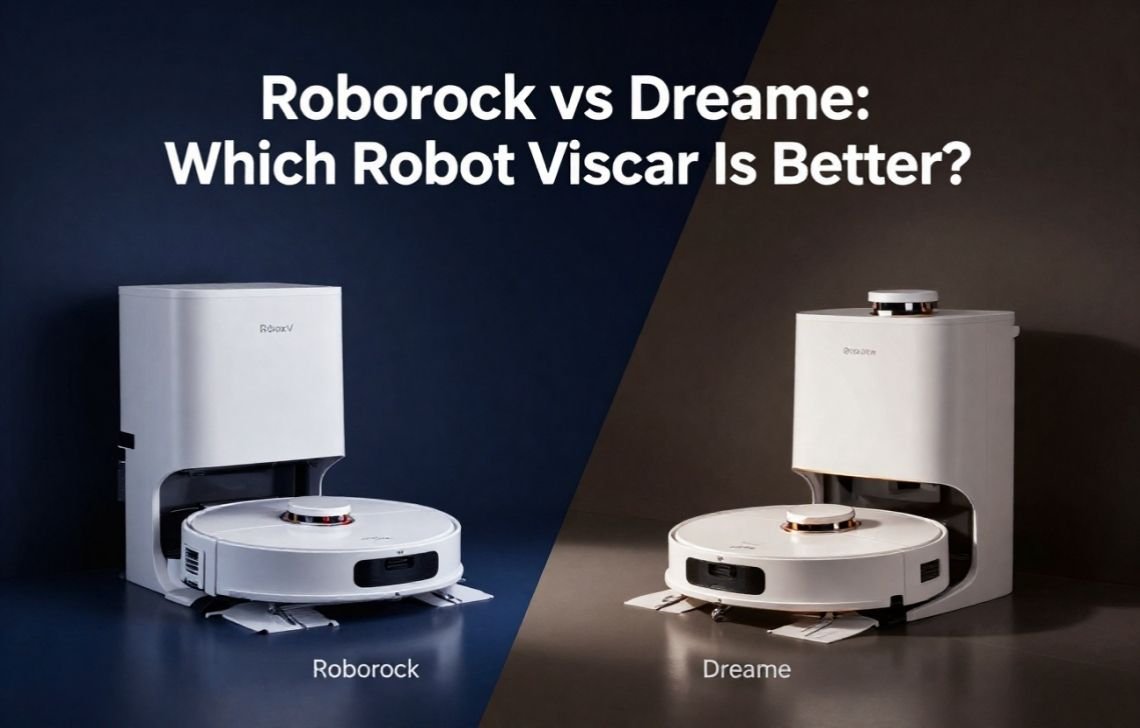
In the competitive landscape of home robotics, Roborock and Dreame have emerged as the two undisputed titans of floor care. Both companies originated in China within a few years of each other—Roborock in 2014 and Dreame in 2017—but they have since followed diverging philosophies that define the current market.
Roborock has successfully navigated the “slow and steady” path to premium status, positioning itself as the “thinking person’s” choice through precision engineering and rock-solid hardware reliability. In contrast, Dreame acts as the “aggressive disruptor,” a brand that iterates at a breakneck pace to offer cutting-edge features—often at prices that undercut the competition by hundreds of dollars. This guide utilizes technical specifications and Vacuum Wars lab data to break down which brand deserves a spot in your home.
Side-by-Side Comparison: Roborock Saros 10R vs. Dreame X50 Ultra
To understand the mechanical differences between these brands, we must look at their current flagship offerings.
Feature | Roborock Saros 10R | Dreame X50 Ultra |
Height | 3.14 inches (No LiDAR tower) | 3.5 inches (Retractable LiDAR) |
Threshold Climbing | 40 mm (AdaptiLift chassis) | 42 mm (single) / 60 mm (two-tier) |
Suction Rating (mfr) | 22,000 Pa | 20,000 Pa |
Obstacle Recognition | 108 objects | 200 objects |
Official Battery Life | 180 minutes | 220 minutes |
Navigation Tech | StarSight 2.0 (3D ToF + RGB) | VersaLift (dToF + AI Camera) |
Brand Philosophies and Build Quality
From a systems engineering perspective, the build quality of these two brands reflects their market positioning. Roborock prioritizes structural integrity and premium materials. Their chassis typically utilize denser plastics and matte finishes that resist fingerprints. With a focus on longevity, Roborock’s engineering is designed for a 4-to-6-year lifecycle, supported by a reputation for industry-leading precision.
Dreame adopts a more pragmatic, feature-first approach. While their build quality is robust, the focus is on functional design and “sci-fi” aesthetics rather than luxury material feel. Dreame’s strategy is to democratize high-end tech; they often include advanced systems—like self-washing mops and AI-guided cameras—in mid-range models that cost significantly less than Roborock’s comparable offerings.
Navigation and Obstacle Avoidance: The Intelligence Factor
The “intelligence” of these robots is a result of how they process spatial data.
- Roborock’s StarSight 2.0: This system represents a major engineering shift by removing the traditional LiDAR tower. It uses VertiBeam lateral-beam technology and 3D Time-of-Flight (ToF) sensors to achieve a 3.14-inch low profile, allowing it to clear furniture that others cannot. In Vacuum Wars testing, the Saros 10R achieved a flawless 24/24 obstacle avoidance score, earning the “Best Obstacle Avoidance” award for 2025.
- Dreame’s VersaLift: Dreame utilizes a mechanical “VersaLift” retractable LiDAR system. While this allows the unit to drop to 3.5 inches, it retains the mapping efficiency of a top-mounted sensor. Its navigation uses 3D Structured Light and AI cameras to identify specific objects like socks or pet accidents. In lab tests, it scored a respectable 20/24, trailing Roborock only in the most complex obstacle densities.
Cleaning Performance: Suction, Brushes, and Mopping
As an engineer, I look past the “Pascal (Pa)” marketing numbers to the actual debris recovery data.
The Suction Paradox While Roborock advertises a higher 22,000 Pa suction rating, the Dreame X50 Ultra actually outperformed it in the carpet deep-clean test, removing 83% of embedded sand compared to Roborock’s 80%. This is due to Dreame’s TurboForce motor and the airflow efficiency of its DuoBrush (tapered rollers) system. Roborock’s DuoDivide brush is SGS-certified for zero hair entanglement, prioritizing maintenance-free operation over raw grit extraction.
Mopping Mechanics
- Stain Removal: Roborock is the superior scrubber, scoring 103 points in dried-on stain removal (well above the testing average of 93).
- Moisture Control: Dreame leaves floors significantly drier (0.5g of residual water vs. 1.1g), which is critical for preventing streaks on high-gloss surfaces.
- Advanced Rollers: Both brands are moving toward continuous-clean rollers, seen in Roborock’s Qrevo Curv 2 Flow and Dreame’s AquaRoll technology, which rinse the mop in real-time during the cycle.
The App Experience: Reliability vs. Innovation
The Roborock App is widely considered the industry standard for stability. It is “mature and reliable,” offering intuitive multi-floor management and stable no-go zones. It is the “set it and forget it” choice for users who want predictable software behavior.
The Dreame App is “feature-rich but evolving.” It offers more granular control and AI features, such as pet snapshots and custom cleaning strategies based on room-specific object recognition. However, the aggressive update cycle can occasionally introduce minor software bugs that require patches.
Product Lineup and Pricing Strategy
Roborock Tiers:
- Q Series: Essential performance/Budget.
- S Series: Mid-range vibrating mop workhorses.
- Qrevo Series: High-value spinning mop models.
- Saros Series: Premium flagship with the industry-first robotic arm for obstacle displacement.
Pricing: Flagships launch at approximately $1,399.
Dreame Tiers:
- D Series: Entry-level essentials.
- L Series: Mid-range models often packing flagship-lite features.
- X Series: High-suction AI flagships.
- Aqua Series: Focused on advanced roller mopping.
- Matrix Series: Features the Multi-Mop Switching Dock for automated hardware swaps.
Pricing: Flagships often launch at $899, with frequent aggressive discounts.
Maintenance and Long-Term Ownership
Roborock offers a premium support experience and high-quality replacement parts, though they are more expensive. However, they typically only offer a 1-year warranty.
Dreame has countered by offering a 3-year warranty on flagship models like the X50 Ultra, providing significant peace of mind. Additionally, Dreame replacement parts (brushes, filters, pads) are generally 20-30% cheaper than Roborock’s. While Roborock’s customer support reputation is currently higher, Dreame is rapidly closing the gap with global infrastructure investments.
Pros and Cons: A Quick Summary
Brand | Pros | Cons |
Roborock | Flawless navigation (24/24), 3.14" ultra-low profile, SGS-certified zero-tangle brushes, superior stain removal. | Higher initial cost ($1,399), 1-year warranty, higher cost for replacement parts. |
Dreame | Best-in-class threshold climbing (60mm), 3-year warranty, superior moisture control (less streaking), 83% carpet deep-cleaning. | Software can have occasional bugs, taller profile (3.5"), faster price depreciation. |
Use Cases: Which Should You Buy?
Choose Roborock If:
- You have a complex layout that requires perfect navigation.
- You have very low-profile furniture (beds/couches) that requires the 3.14″ clearance.
- You prioritize the highest build quality and a stable, “mature” app experience.
Choose Dreame If:
- You have high thresholds or sliding door tracks (the 60mm retractable legs are a game-changer).
- You have heavy pet hair needs (Dreame scored 97.5% on flattened pet hair pickup vs. Roborock’s 91.5%).
- You want the best “bang for your buck” and a significantly longer 3-year warranty.
The Verdict: Which Brand Wins?
In the head-to-head lab evaluation by Vacuum Wars, the Roborock Saros 10R edged out the Dreame X50 Ultra by 1.2 points (28.2 vs 27.0). Roborock takes the crown for those who demand “perfection” in navigation and battery efficiency. However, Dreame’s superior carpet cleaning, massive threshold-climbing ability, and 3-year warranty make it the more practical choice for many modern homes. The “winner” ultimately depends on whether you value the refined precision of Roborock or the aggressive innovation and value of Dreame.
FAQs
Which is better for high thresholds?
Dreame is the undisputed leader. Its retractable “legs” allow it to climb up to 60mm over two-tier thresholds, whereas Roborock is limited to 40mm via its AdaptiLift chassis.
How do they handle pet hair?
Both are elite. In a 7-inch hair test, both the DuoDivide and DuoBrush systems achieved 0% hair tangles. However, Dreame is slightly better for carpeted homes with pets, picking up 97.5% of flattened hair.
Which has better obstacle avoidance?
Roborock. The Saros 10R’s StarSight 2.0 system earned “Best of 2025” for a perfect 24/24 score, while Dreame avoided 20/24 objects.
Do the docks wash and dry mops automatically?
Yes. Both premium docks feature hot water washing, heated air drying, and auto-detergent dispensing.