
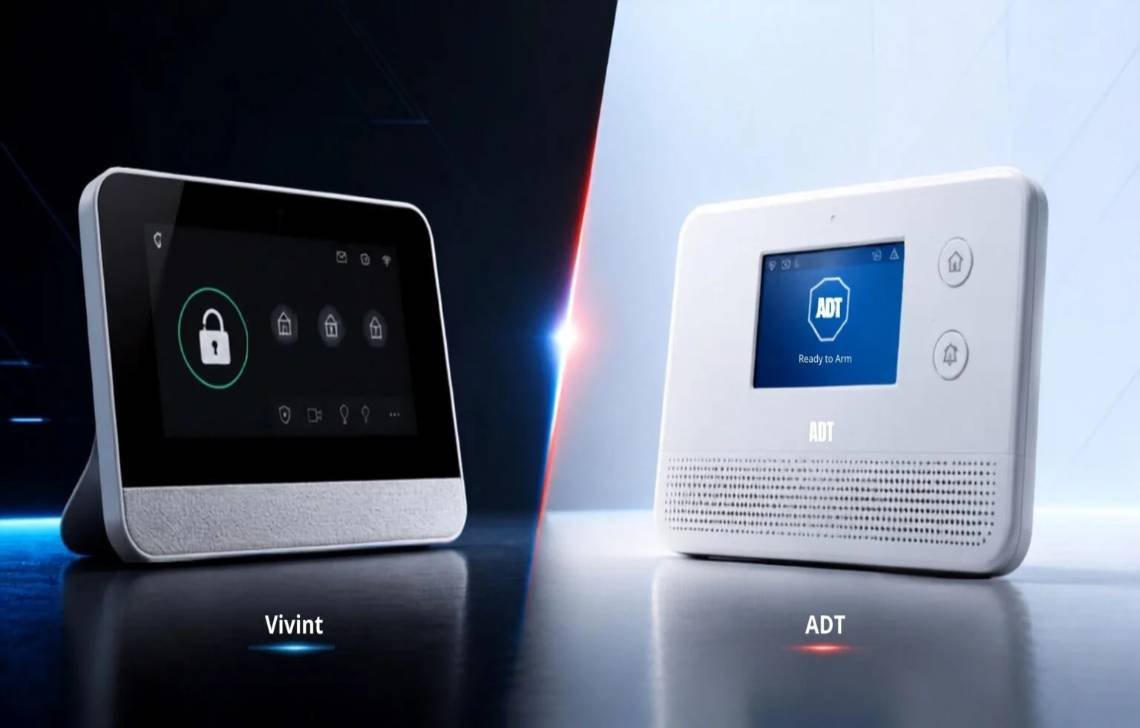
Navigating the home security market in 2026 requires more than just a passing interest in cameras; it requires an understanding of two vastly different operational philosophies. On one side of the ring stands ADT, a titan with over 150 years of institutional knowledge, six redundant monitoring centers, and a recently forged partnership with Google Nest that has modernized its aging hardware stack. On the other side is Vivint, a high-tech disruptor that has spent the last two decades perfecting a proprietary, vertically integrated smart home experience that feels like “living in the future.”
The Vivint vs ADT debate is the ultimate industry showdown. It pits the sheer infrastructure and reliability of an established giant against the sleek automation and technical agility of a modern innovator. For homeowners, the choice isn’t just about which sensor to buy—it is about the length of the financial commitment, the quality of the monitoring response, and whether you want your hardware to work if you ever decide to cancel your service.
In this deep-dive analysis, we will deconstruct the Vivint vs ADT rivalry. You will learn:
- The reality of “upfront costs” vs. long-term equipment financing.
- The technical nuances between Vivint’s proprietary Z-Wave hub and ADT’s Google Nest ecosystem.
- Why monitoring redundancy (6 centers vs. 2) is a critical metric for “reliability first” homeowners.
- The contractual pitfalls, including Vivint’s controversial three-day return window.
At a Glance: Side-by-Side Comparison Table
As a Senior Analyst, I advise looking past the marketing headers. The table below synthesizes technical specifications and real-world testing data to show how these providers actually compare.
Criteria | ADT (Pro Install) | Vivint |
Starting Monthly Price | $49.99 | $24.99 - $50.00+ |
Upfront Costs | $99 - $599 (Installation) | $199 (Install) / Up to $3,400 (Equipment) |
Equipment Philosophy | Partner Brands (Google Nest) | Proprietary (In-House Engineering) |
Contract Length | 36 Months (24 in CA) | 48 - 60 Months (Financing-linked) |
Response Time (Tested) | 28 Seconds | 33 Seconds |
Monitoring Centers | 6 Redundant Centers | 2 Centers |
Money-Back Guarantee | 6 Months (Service-related) | 3 Days (Industry Outlier) |
Automation Protocol | Google Home / Z-Wave | Proprietary Smart Hub / Z-Wave |
App Rating (iOS/Android) | 4.8 / 4.6 | 4.6 / 3.8 |
Installation | Professional (DIY via ADT Blu) | Professional Only |
In-Depth Feature Analysis: Proprietary Tech vs. Partner Ecosystems
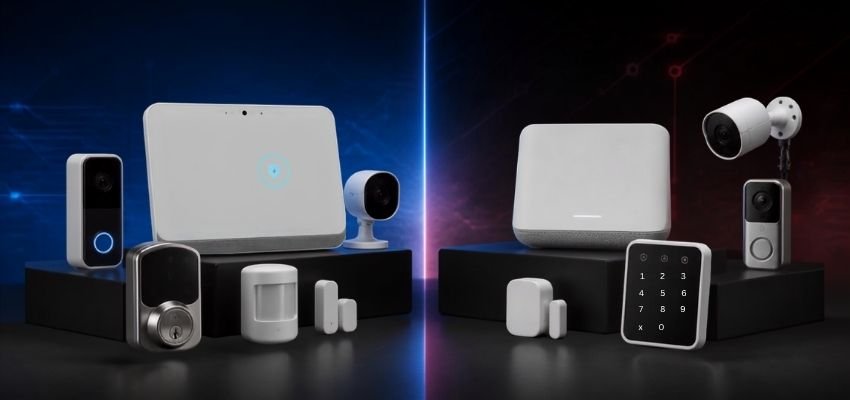
The hardware divergence in the Vivint vs ADT matchup represents two distinct business models. Vivint operates as a closed-loop system. Their flagship Smart Hub is a tablet-like touchscreen controller that serves as the “brain” of the home. This hub utilizes a proprietary Z-Wave integration to bridge security sensors with smart home devices like locks and thermostats.
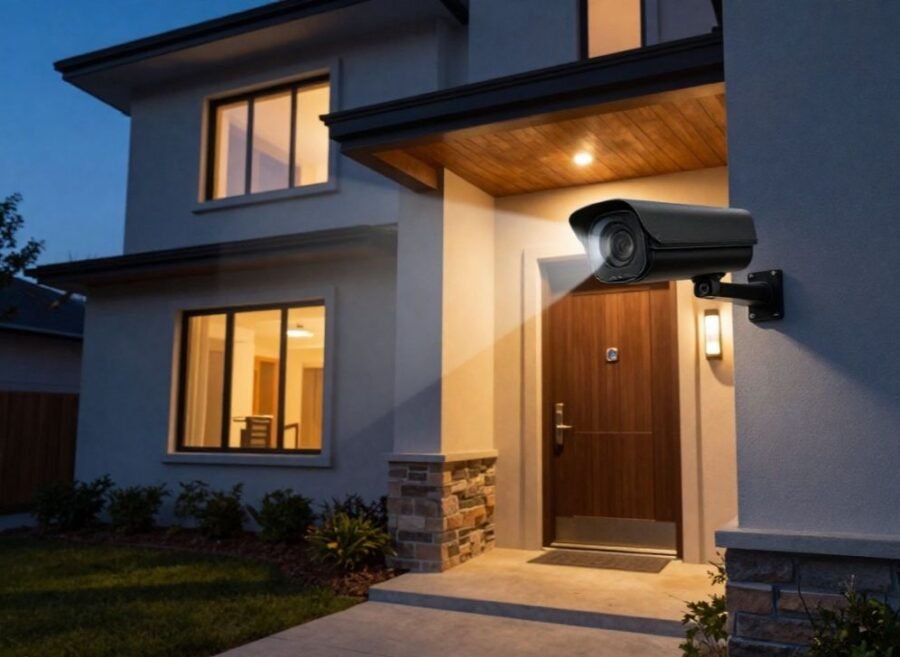
Technically, Vivint’s “automated responses to threats” are what set it apart. For instance, if the Vivint Outdoor Camera Pro (Gen 2) detects a person in a “protected zone” after hours, the Smart Hub can be programmed to simultaneously lock all Z-Wave smart locks, flash the outdoor camera’s LED ring red, and sound a 104-decibel siren. This level of granular, “if-this-then-that” (IFTTT) logic is handled locally on the hub, ensuring speed and reliability.
ADT, conversely, has shifted away from the proprietary touchscreen model in favor of a utilitarian, screenless hub with a built-in physical keypad. For its “eyes and ears,” ADT relies on its partnership with Google Nest. This provides users with the high-end Google Nest Cam (Battery), Nest Doorbell, and Nest Cam with Floodlight.
From an integration specialist’s perspective, ADT’s greatest hardware advantage is the “standalone” factor. If you cancel your ADT service, your Google Nest hardware remains functional as a standalone smart home device through a Google Home Premium subscription. With Vivint, the proprietary gear is heavily “locked-in” to their ecosystem; if you terminate the service, the advanced automation features that make the gear worth the premium price point effectively vanish.
Performance and Monitoring Reliability
Monitoring is the “product” that truly matters when a crisis occurs. In the Vivint vs ADT comparison, ADT holds a clear lead in infrastructure. ADT operates six redundant monitoring centers across the U.S. and Canada. This redundancy is not just a marketing statistic; it is a fail-safe. If a hurricane or a regional power outage takes a center in Florida offline, five other facilities are prepared to absorb the monitoring load instantly.
During our internal testing, ADT clocked an average response time of 28 seconds. This speed is bolstered by ADT’s “SMART Monitoring” feature, which sends a text message to the homeowner the moment an alarm is triggered. This allows the user to either cancel a false alarm with a tap or request immediate emergency assistance, bypassing the need for a traditional phone call in high-stress moments.
Vivint operates two monitoring centers. While their 33-second average response time is respectable and well within industry standards, the lack of geographic redundancy compared to ADT‘s network is a point of consideration for homeowners in disaster-prone areas.
The real-world value of this 24/7 oversight is best illustrated by user data from our sources. One homeowner reported that an ADT-monitored system detected an electrical fire while the family was away; because the center was redundant and always active, fire crews arrived within 10 minutes, saving the structure. Another account from a Retired SWAT Commander highlights a hurricane survivor whose ADT carbon monoxide sensors alerted him to fumes leaking from a generator in the garage—a scenario that could have been fatal without professional monitoring. Both Vivint and ADT provide these life-saving environmental sensors, but ADT‘s larger network provides a thinner margin for error.
Pricing and Contractual Commitment
The financial structures of Vivint vs ADT are often the most contentious point for consumers. Our research, including analysis of user reports on platforms like Reddit, reveals that the “low entry price” for Vivint is often a misconception. While Vivint‘s monthly monitoring starts at $24.99, this is a “base-only” price. Once you add video storage, automation, and equipment financing, most users report monthly bills between $50 and $70.
More importantly, the equipment cost for Vivint can be astronomical. A comprehensive setup for a large home can reach $3,400 upfront. Most consumers choose to finance this cost, which then ties them into a 48 to 60-month (4-5 year) contract. This is one of the longest commitments in the industry.
ADT has a higher monthly starting point of $49.99 for professional monitoring, but their contracts are standard at 36 months (reduced to 24 months in California). This provides a faster exit ramp for homeowners who may want to switch providers later. Furthermore, ADT offers the ADT Blu line, which provides a DIY alternative with no long-term contract requirements, a flexibility that Vivint does not currently match.
One significant warning for Vivint customers: the “moving fee.” Vivint typically charges a $129 fee to relocate your system. Because Vivint gear often uses a “hybrid wireless approach”—which involves drilling through exterior walls to fish wires for cameras—the re-installation is not a DIY task. ADT‘s moving process is often described as more streamlined, frequently offering discounts for new equipment at the new residence.
Ease of Use and Mobile Experience
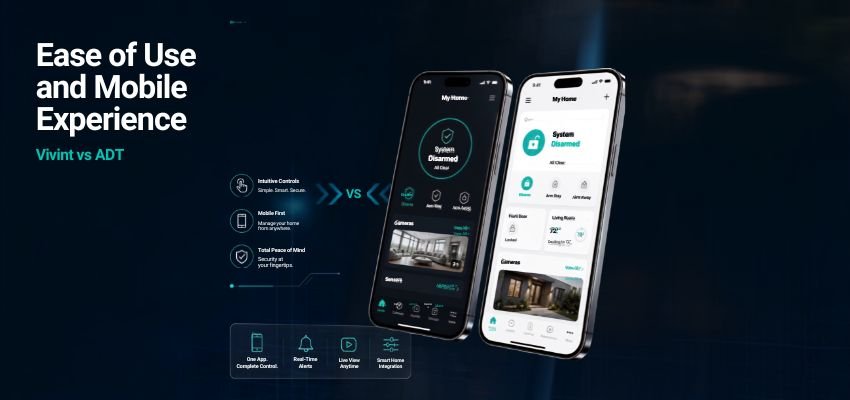
As an integration specialist, I find that a security system is only as effective as the interface the user interacts with daily. In the Vivint vs ADT app battle, the ratings lean toward ADT.
The ADT+ app (rated 4.7-4.8) is lauded for its utilitarian stability. It excels at the basics: arming, disarming, and providing clear, high-bitrate live streams from Google Nest cameras. It is designed for the homeowner who wants their security to be an invisible, reliable background process.
The Vivint Smart Home app (rated 3.8-4.6) is more of a “command and control” center. It is undeniably more powerful than ADT+ when it comes to automation. You can speak to visitors via the doorbell, adjust Z-Wave thermostats, and view detailed event clips all from one screen. However, Android users have reported more bugs and lag compared to the iOS version, which accounts for the lower Google Play score. For the “Smart Home Enthusiast,” the Vivint app’s ability to create complex “scenes” (e.g., “Goodnight” mode which locks doors, arms sensors, and dims lights) is the gold standard.
Customer Support and Industry Reputation
The industry reputation for both Vivint vs ADT is complicated by the aggressive nature of door-to-door sales. Reddit threads are filled with warnings about “high-pressure” tactics from both brands.
However, from a consumer protection standpoint, Vivint’s cancellation policy is a significant risk. Vivint offers a mere three-day money-back guarantee. In the world of home security, where it may take a week to truly “live with” a system and identify its quirks, a 72-hour window is arguably predatory and an industry outlier.
ADT offers a headline-grabbing six-month money-back guarantee, but as an analyst, I must highlight the “dodgy” fine print. This guarantee only applies if there is a technical defect that ADT cannot resolve. It is not an “I changed my mind” return policy. That said, even a service-restricted 6-month window is more consumer-centric than Vivint’s 3-day limit.
The service side of the business for both companies is described by former technicians as “brutal.” While both are excellent at getting a system installed and collecting the initial payment, the service-side support for fixing a faulty sensor six months later can be hit-or-miss. For homeowners seeking a “threat assessment,” both brands do an excellent job during the professional installation phase; technicians from both Vivint and ADT are trained to identify vulnerable entry points like basement windows or side doors that the average homeowner might overlook.
Pros and Cons: The Definitive Breakdown
Vivint Pros and Cons
Pros:
- Technological Leader: The Smart Hub and proprietary cameras (like the Outdoor Camera Pro) offer the best tech in the market.
- Advanced Automation: Seamless Z-Wave integration allows for deep “automated threat responses.”
- Professional Assessment: Expert installation ensures all high-risk areas are covered.
Cons:
- Financing Trap: Equipment costs can reach $3,400, leading to 5-year contracts.
- Predatory Return Policy: The 3-day cancellation window is the shortest among major competitors.
- Proprietary Lock-in: Hardware has limited utility if the professional service is cancelled.
ADT Pros and Cons
Pros:
- Operational Excellence: 150 years of experience and 6 redundant monitoring centers provide unmatched reliability.
- Shorter Commitments: 3-year contracts (2 years in CA) are more flexible than Vivint.
- Google Nest Integration: High-quality cameras that work as standalone devices if you cancel the service.
- SMART Monitoring: Ability to cancel false alarms or request help via text message.
Cons:
- Dated Control Interface: The lack of a touchscreen hub may feel behind the times for some users.
- Higher Base Monitoring: Monthly fees start at nearly $50 regardless of equipment.
Use Cases: Which One is Best for You?
The “Smart Home Enthusiast”
If you want your home to act as a proactive participant in your security, Vivint is the clear winner. For those who want the best-in-class Outdoor Camera Pro and a tablet-like hub to manage a complex array of smart locks, lights, and thermostats, Vivint offers a “living in 2030” experience that ADT‘s keypad-and-app model can’t match.
The “Reliability First” Homeowner
If your primary concern is the fastest possible response time and a monitoring network that will never go dark, choose ADT. Their 28-second response time and six redundant centers make them the “Operational Winner.” This is for the homeowner who views security as a critical utility rather than a tech hobby.
The Renter
We strongly recommend ADT (specifically the ADT Blu DIY line) for renters. Standard Vivint installations often involve drilling through exterior walls to fish wiring for cameras—a practice most landlords will not tolerate. ADT‘s DIY options and lower-impact professional installations are much more landlord-friendly.
The Verdict: Vivint vs ADT Winner
Declaring a winner in the Vivint vs ADT showdown requires balancing technological flair against operational muscle.
ADT is the Operational Winner. With a monitoring infrastructure that is significantly more robust (6 centers vs. 2), a faster tested response time, shorter contract lengths, and a more forgiving (though still limited) money-back guarantee, ADT provides the better “value per dollar” for the average homeowner. Their pivot to Google Nest hardware ensures that your investment in cameras isn’t rendered useless if you ever decide to leave the ADT ecosystem.
Vivint remains the Technological Winner. If you are willing to accept the higher equipment costs ($3,400+) and the restrictive 5-year financing contract, you will own the most advanced and highly automated security system in North America.
For the vast majority of consumers, ADT’s superior redundancy and more flexible contract terms make it the safer and more reliable investment.
FAQs
Do ADT or Vivint work if the internet goes down?
Yes. Both ADT and Vivint include cellular backup as a standard feature in their professional monitoring plans. This ensures that even if your Wi-Fi is cut by a thief or your power goes out during a storm, your system can still communicate with the monitoring centers.
Is Vivint worth the money?
Vivint is worth the investment for those who prioritize proprietary, high-end hardware and advanced automation. While monthly monitoring ranges from $25 to $50, remember that equipment financing will likely push your total monthly cost higher. For many, the advanced “deter” features of the Vivint Outdoor Camera Pro justify the premium.
What is the response time for Vivint vs ADT?
In standardized testing, ADT averaged a response time of 28 seconds, while Vivint averaged 33 seconds. Both are well above the industry average, but ADT‘s 6-center redundancy gives it the edge in speed.
Can I install these systems myself?
Vivint requires professional installation for all systems. ADT also primarily focuses on professional installation, but they offer a dedicated DIY line called ADT Blu for those who want to avoid installation fees and long-term contracts.