
Water damage is a silent, high-stakes threat. A hidden leak inside a wall can cause catastrophic structural damage before it is ever noticed, often resulting in thousands in remediation costs.
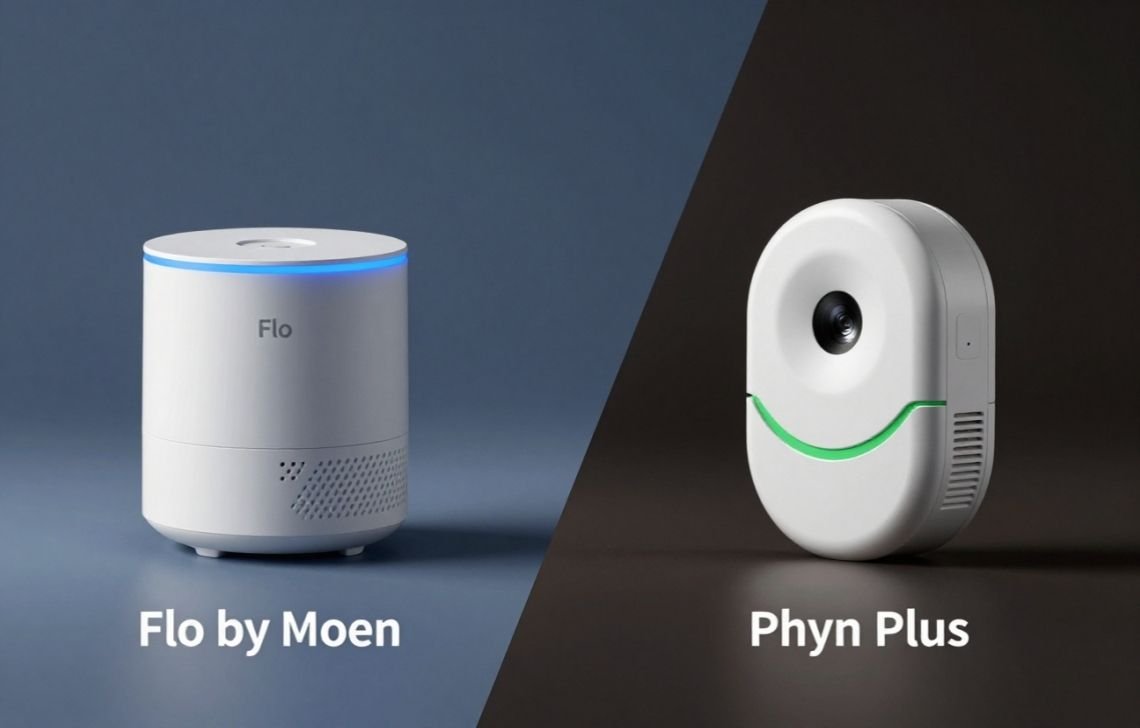
As a professional plumbing consultant, I’ve tested the industry leaders—Flo by Moen vs Phyn—head-to-head across months of field testing. We evaluated everything from GPM flow rates to hydrostatic pressure signatures.
This comparison provides data-driven insights into which device will actually protect your property. Whether you are managing a one-bathroom cottage or a sprawling “castle,” the technical nuances of these systems matter.
At-a-Glance: Quick Comparison Table
Feature | Flo by Moen | Phyn Plus |
Detection Technology | Turbine / Impeller & Pressure Sensor | Ultrasonic Flow & Pressure Sensors |
Learning Period | Fixed 7-Day Cycle | Adaptive (~1,000 events / 1 month) |
Smallest Leak Detected | High (6.5-second automatic catch) | Manual via PSI Logs (down to 4s) |
Hardware Design | Mechanical (Moving Parts) | Solid State (No Moving Parts) |
Best For | "Set it and forget it" users | Data-driven users & complex plumbing |
Hardware Showdown: Turbine vs. Ultrasonic Sensors
Flo by Moen utilizes a mechanical impeller to measure the physical movement of water. While effective at measuring flow, this design relies on moving parts that are in constant contact with your water supply.
Phyn Plus uses a solid-state ultrasonic design with no moving parts. It measures both flow and pressure signatures simultaneously, allowing the device to “fingerprint” specific fixtures in your home.
Phyn’s algorithm can distinguish between a shower and an outdoor hose bibb. In my testing, Phyn allowed a “known” irrigation event to run for 274 gallons, yet flagged an unusual signature after only 19 gallons of use.
The Learning Curve: Adaptive Algorithms vs. Hard Timelines
Flo by Moen operates on a strict one-week learning cycle. During these seven days, the auto-shutoff is disabled while the algorithm observes your home’s standard water habits.
Phyn Plus takes an adaptive approach, requiring roughly 1,000 water events (about a month for most homes) to fully mature. However, Phyn allows you to enable auto-shutoff on day one.
This “day one” shutoff is a critical feature for vacation homes. You can protect an unoccupied property immediately rather than waiting for a mandatory seven-day “learning” window to expire.
Leak Detection Performance: The Real-World Test Results
Large to Medium Leaks
Both units are exceptional at catching catastrophic pipe bursts. However, Phyn’s signature recognition makes it more intelligent; it won’t shut your water off during a long irrigation cycle if it recognizes the fixture.
Small Leak Detection (The "Drip" Test)
In my automated testing, Flo caught a leak at the 6.5-second mark but reached its failure point at 52 seconds. This means Flo is highly sensitive for immediate, automated alerts on small drips.
Phyn Plus can detect leaks as small as 4 seconds, but these often require manual review in the app’s logs. In manual “Deep Check” modes, both devices can identify a leak as tiny as one drop every 4 minutes.
To visualize the impact of these “small” leaks inside a wall:
- Drop every 10 seconds: Equals 6 cups of water per day.
- Drop every 4 seconds: Equals 15 cups of water per day.
- The Risk: 15 cups of water trapped in your subfloor daily will cause rot and mold long before you see a surface stain.
User Experience: App Insights and Data Transparency
The Phyn Plumbing Check Log is a data enthusiast’s dream. It shows the exact PSI (pounds per square inch) drop during a test, allowing you to establish a baseline.
If your baseline is a 0.14 PSI drop and you see it jump to 0.3 PSI, you have a leak. I discovered a failing gasket on a toilet diaper sprayer this way—it was leaking one drop every 8 seconds before any alert was triggered.
The Flo Health Test prioritizes simplicity over raw data. It runs a 30-second to 4-minute check and provides a “Congrats! You’re Secure” message, which is perfect for homeowners who don’t want to analyze PSI graphs.
Longevity and Maintenance: The Corrosion Factor
From a consultant’s perspective, hardware longevity is paramount. Because Flo by Moen uses a turbine with magnets, it is susceptible to mineral buildup and corrosion over time, especially in hard water areas.
Corrosion on the turbine magnets can eventually degrade the accuracy of the flow sensor. Phyn’s solid-state design is agnostic to water quality, as there are no internal moving parts to seize or corrode.
Pros and Cons: A Transparent Breakdown
Flo by Moen
- Pros: Fast, automated alerts for small drips; user-friendly “Secure” notifications; faster initial setup.
- Cons: Moving parts are prone to corrosion; rigid 7-day learning timeline; less granular data for manual troubleshooting.
Phyn Plus
- Pros: Solid-state hardware (no moving parts); granular PSI logs; recognizes fixture signatures; immediate shutoff capability.
- Cons: Requires manual log review for the smallest drips; longer learning period for the algorithm to mature.
Final Verdict
Choose Flo by Moen if: You want a “set it and forget it” experience. It is the best choice for standard homes where you want the system to handle the thinking and alert you only when an action is required.
Choose Phyn Plus if: You have a “castle” or complex plumbing with high water volume. It is the superior choice for those who want deep data transparency and hardware that won’t succumb to mechanical wear and tear.
FAQs
Does Phyn Plus or Flo by Moen detect small leaks better?
Flo is better at sending automatic alerts for small leaks. Phyn is capable of detecting even smaller leaks, but you must manually monitor the PSI logs to find them before they reach the alert threshold.
Can these devices prevent all water damage?
No. These devices are designed to minimize catastrophic loss by stopping the flow. They cannot prevent the initial damage that occurs between the start of the leak and the moment the valve closes.
What is thermal expansion in plumbing?
In a closed plumbing system, heating water causes it to expand, increasing hydrostatic pressure. A check valve prevents this pressure from bleeding back into the city main, causing PSI spikes that smart sensors must account for.
How long does the Flo by Moen learning period last?
The Flo by Moen learning period is a hard-coded 7-day cycle. During this week, the system observes patterns and the auto-shutoff feature remains disabled to prevent false positives.