
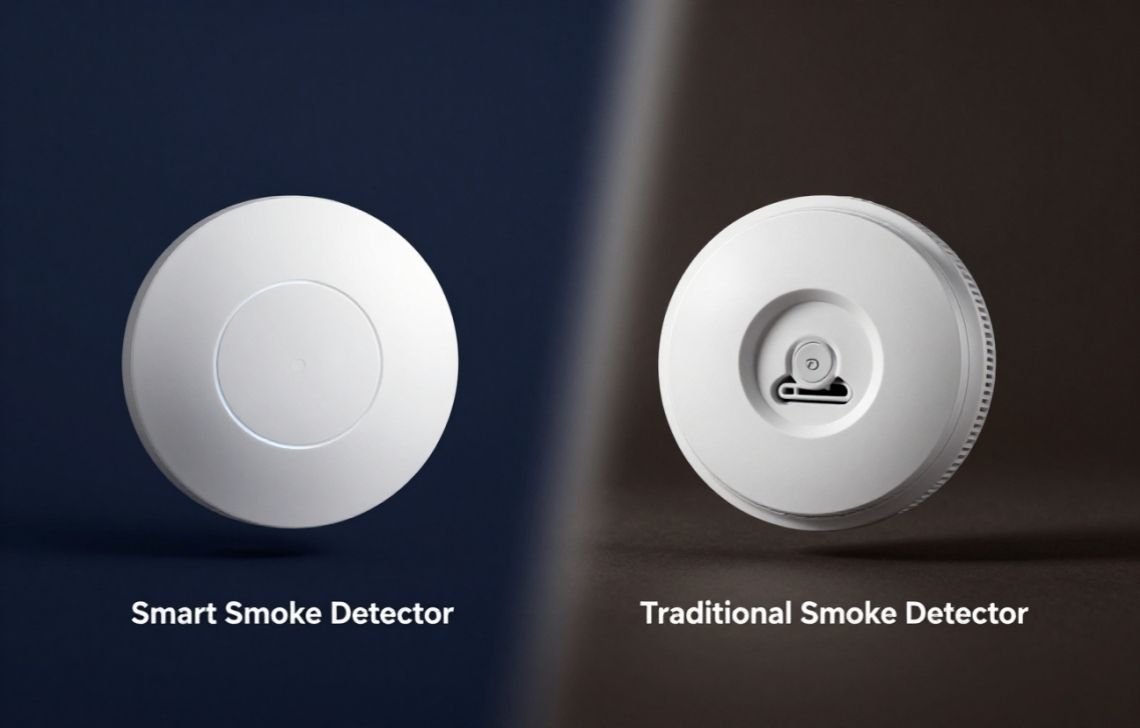
For decades, residential fire safety was defined by a “passive” methodology. The industry standard relied on the installation of a standalone Traditional Smoke Detector that remained dormant until a crisis occurred. When smoke was detected, these devices emitted a high-decibel local siren, leaving the safety of the home entirely dependent on the physical presence of an occupant to hear the alarm and take action. While these units have saved millions of lives, the advent of the Internet of Things (IoT) has ushered in a paradigm shift toward “active” safety systems.
In the modern smart home landscape, the Smart Smoke Detector has emerged as a sophisticated, proactive safety hub. This evolution represents more than just a change in how we hear an alarm; it is a fundamental transformation in how we manage residential risk. This article will dissect the technical architecture of both systems, evaluate the long-term cost-benefit ratios, and examine how emerging interoperability standards like Matter over Thread are making life-safety networks more resilient than ever before. Whether you are a tech enthusiast or a safety-conscious homeowner, understanding the shift from a Traditional Smoke Detector to a Smart Smoke Detector is essential for protecting your property and family in the 21st century.
Understanding Traditional Smoke Alarms
The Traditional Smoke Detector is the ubiquitous device found in nearly every home worldwide. These units are designed for singular, local functionality, operating either through a hardwired 120V connection with a battery backup or as purely battery-operated standalone units. To understand their limitations, one must first understand the two primary sensor technologies they employ:
- Ionization Sensors: These are engineered to detect fast-flaming fires—combustions that produce small, invisible smoke particles. They utilize a trace amount of Americium-241 to ionize the air in a sensing chamber. When smoke particles enter, they disrupt the flow of ions, breaking the electrical circuit and triggering the siren.
- Photoelectric Sensors: These sensors are far more effective at detecting smoldering fires, which often smolder for hours before bursting into flames and produce larger, visible smoke particles. They function using a light source and a light sensor oriented at an angle. When smoke enters the chamber, it scatters the light onto the sensor, activating the alarm.
While a Traditional Smoke Detector is a reliable tool for basic code compliance, it suffers from significant “active” safety hurdles. Most notably, they offer zero remote awareness. If a fire breaks out while you are at work or traveling, the alarm sounds to an empty house. Furthermore, the notorious “2 a.m. chirp”—a low-battery notification—often occurs at inconvenient times, leading many homeowners to dismantle the unit entirely, creating a massive safety gap.
What Makes a Smoke Detector "Smart"?
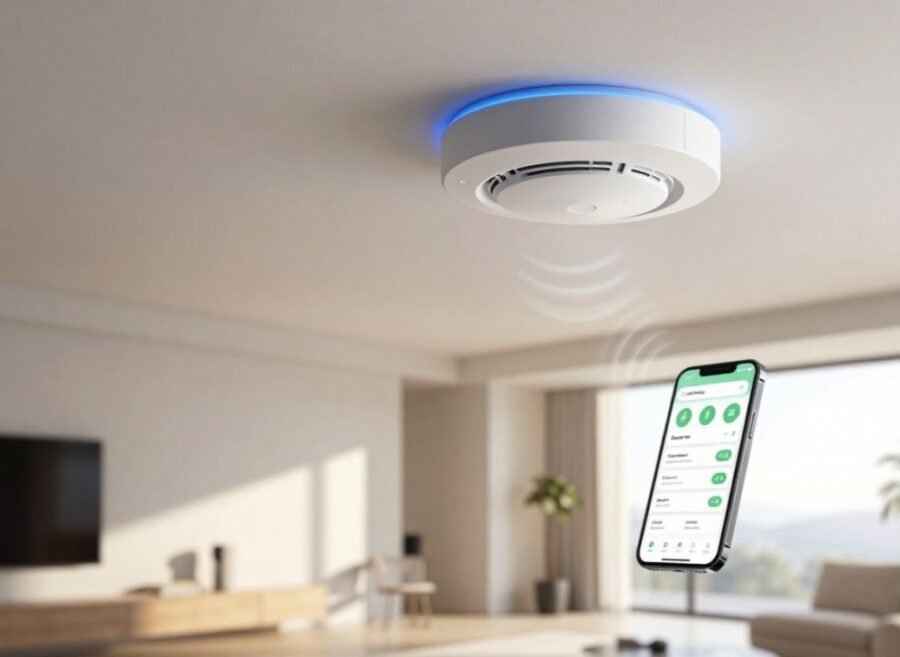
A Smart Smoke Detector takes the proven sensor mechanics of a Traditional Smoke Detector and integrates them with a robust communication module. By utilizing protocols like Wi-Fi, Zigbee, Z-Wave, or Matter over Thread, these devices become nodes in a larger digital ecosystem. This connectivity transforms the device from a simple siren into an intelligent safety monitor with four defining features:
- Real-Time Mobile Alerts: This is the pinnacle of modern fire safety. A Smart Smoke Detector sends an immediate push notification to your smartphone the moment a hazard is detected. This remote awareness allows you to contact emergency services even if you are thousands of miles away, potentially preventing a total property loss.
- Voice Alerts and Location Identification: High-end models, such as the Google Nest Protect, replace the confusing, high-pitched siren with a human voice. This voice provides critical context by announcing the hazard type (smoke vs. carbon monoxide) and the specific location (e.g., “Smoke detected in the kitchen”). This reduces panic and helps occupants choose the safest evacuation route.
- Wireless Interconnectivity: In a standard setup, a Traditional Smoke Detector in the basement may not be audible in a third-floor bedroom. A Smart Smoke Detector solves this through wireless interconnectivity. If one unit detects danger, every unit in the home sounds the alarm simultaneously, ensuring no occupant is left unaware of a distant threat.
- App-Based Control and Monitoring: Through a dedicated mobile application, users can perform remote “hushing” of false alarms (such as those triggered by burnt toast) and receive digital health reports. The app tracks sensor health and battery levels, providing a proactive maintenance schedule that traditional units lack.
Technology Deep Dive: The Power of Matter over Thread
For years, the adoption of the Smart Smoke Detector was hindered by interoperability hurdles. Homeowners often had to choose a single brand and stick with it, leading to vendor lock-in and fragmented systems. This has been solved by the introduction of Matter, a universal communication standard, paired with Thread, a low-power mesh networking protocol.
As a safety specialist, I cannot overstate the importance of a Matter smoke detector using Thread technology. Thread is built on the 802.15.4 radio standard and utilizes 6LoWPAN (IPv6 over Low-Power Wireless Personal Area Networks). Unlike Wi-Fi, which can suffer from high latency and “dead zones” caused by RF interference in the 2.4GHz spectrum, Thread creates a self-healing mesh.
- Self-Healing Mesh Reliability: In a Thread-enabled home, every mains-powered device (such as a smart plug) acts as a repeater. If a communication path to a Smart Smoke Detector is blocked or a router goes offline, the network automatically reroutes the signal through other nodes. This eliminates the “single point of failure” common in Wi-Fi setups.
- Latency and Efficiency: Thread is designed specifically for low-bandwidth, low-latency communication. This means the time between a sensor trigger and your phone receiving an alert is minimized. Furthermore, the low power consumption allows a Smart Smoke Detector to maintain a constant connection for years on a single battery.
Expert Tip for Mesh Strength: To maximize the reliability of your safety network, homeowners should strategically place Matter-enabled smart plugs throughout the home. These act as “Thread Routers” that reinforce the mesh, ensuring your Smart Smoke Detector has multiple redundant paths to reach the Thread Border Router.
Side-by-Side Comparison: Head-to-Head Breakdown
Feature | Traditional Smoke Detector | Smart Smoke Detector |
Alerts | Loud, local siren only. | Local siren + voice alerts + real-time smartphone notifications. |
Remote Safety | None; requires physical presence to hear the alarm. | Full remote awareness and emergency control via mobile app. |
Interconnectivity | Requires physical traveler wires for interconnected units. | Software-defined wireless mesh; all units sound and identify location. |
Convenience | Manual testing (ladder required); manual battery replacement. | App-based testing, automatic self-checks, and remote silencing. |
Detection Type | Single or dual-sensor (Ionization/Photoelectric). | Often includes dual smoke/CO sensors and air quality monitoring. |
Installation | Battery units are simple; hardwired require an electrician. | Generally simple battery-powered setup; integrates with Matter hubs. |
Initial Cost | Low (typically under $20). | Higher ($50 – $150+); an amortized safety investment. |
In-Depth Comparison: Performance and Usability
Battery Life & Solar Charging
Features
The feature set of a Traditional Smoke Detector is inherently limited to detection and sound. In contrast, a Smart Smoke Detector functions as a multi-sensor safety hub. Modern smart units often include Carbon Monoxide (CO) detection and even humidity or temperature sensors to provide a holistic view of the home’s environment. While the simple siren of a Traditional Smoke Detector can lead to confusion during a middle-of-the-night emergency, the voice-guided alerts of a smart system provide the clarity needed for a decisive evacuation.
Performance
From a performance standpoint, the Traditional Smoke Detector is a standalone silo. If it fails, there is no system to notify you. A Smart Smoke Detector leveraging Matter over Thread technology offers a much higher performance ceiling due to its digital redundancy. Because these devices perform automatic self-tests and report their status to a hub, you are notified immediately if a sensor is failing or if there is excessive RF interference in the 2.4GHz spectrum that might compromise the signal.
Pricing
Pricing is often where homeowners hesitate. A Traditional Smoke Detector is undeniably the cheapest entry point. However, I encourage clients to view the Smart Smoke Detector as an amortized safety investment over a 7-year lifecycle. If a smart unit costs $100 and lasts 7 years, you are paying roughly $1.19 per month for the ability to protect your home while you are away. Compared to the potential deductible for fire damage, the smart unit offers superior financial value.
Ease of Use
The “ease of use” factor is where the Smart Smoke Detector truly shines. The ability to silence a false alarm from your phone—rather than standing on a chair with a broom handle to reach a Traditional Smoke Detector—is a significant quality-of-life improvement. Furthermore, app-based testing allows you to verify every alarm in the house with a single tap, ensuring you actually perform the monthly safety checks that most people skip with traditional units.
Customer Support
Support for a Traditional Smoke Detector usually ends at the point of sale. If it chirps, you replace the battery or the unit. A Smart Smoke Detector offers proactive support through digital status updates. Companies can push firmware updates to improve sensor algorithms and reduce false alarms, ensuring your device gets “smarter” over its lifespan—something a Traditional Smoke Detector simply cannot do.

Pros and Cons: A Balanced View
Traditional Smoke Detector Pros:
- Lowest Initial Cost: Highly accessible for basic code compliance.
- Zero Connectivity Required: Works in homes without internet or smart hubs.
- Simple Operation: No apps to manage or firmware to update.
Traditional Smoke Detector Cons:
- Local Only: No protection for the home when occupants are away.
- High False Alarm Friction: Must be manually silenced, often requiring a ladder.
- Silent Failures: No notification if the battery dies or the sensor fails between manual tests.
Smart Smoke Detector Pros:
- Remote Awareness: Instant smartphone alerts provide peace of mind globally.
- Interconnected Mesh: Wireless communication ensures the whole house is alerted.
- Voice Location: Identifies the specific room and hazard type.
- Matter Compatibility: Future-proofs your home by working across Apple HomeKit, Google Home, and Alexa.
Smart Smoke Detector Cons:
- Higher Upfront Investment: Requires more capital to outfit a full home.
- Tech Requirements: Requires a compatible smart home hub or Thread Border Router.
Who Should Choose What?
- The Traditional Smoke Detector: This remains an acceptable choice for small, single-room studio apartments or budget-conscious individuals who are almost always home. It serves as a fundamental “better than nothing” solution that meets legal safety requirements.
- The Smart Smoke Detector: This is the non-negotiable recommendation for families, owners of multi-level homes, and frequent travelers. If you have a large property, the interconnectivity ensures a basement fire alerts the master bedroom immediately. For tech-integrated households, the Smart Smoke Detector is the only choice that aligns with a modern “active” safety philosophy.
Top Recommendation: The Sensereo MS-1 and MSC-1
When selecting the best hardware, I recommend the Sensereo MS-1 and its carbon-monoxide-integrated sibling, the MSC-1 Smoke & CO Alarm. Unlike many older smart alarms that rely on legacy Wi-Fi—which can be a battery drain and prone to interference—the MS-1 is a native Matter over Thread device.
The engineering of the Sensereo MS-1 is particularly impressive due to its dual-battery design. It contains a sealed, non-replaceable battery that powers the core smoke detection sensor for its entire 7-year lifespan. A separate, user-replaceable CR123A battery handles the Matter over Thread communication module. This ensures that even if the communication battery is depleted, the fundamental safety function of the Smart Smoke Detector remains active. With its 7-year warranty, the Sensereo MS-1 is the gold standard for reliable, long-term residential safety.
The Verdict: Is the Upgrade Worth It?
While a Traditional Smoke Detector satisfies the bare minimum of fire code, it leaves significant gaps in your home’s defense. A Smart Smoke Detector bridges those gaps by offering remote monitoring, voice guidance, and a self-healing mesh network. The ability to react to a fire while you are at work or on vacation is a game-changer that can prevent a minor incident from becoming a catastrophe. In my professional opinion, the transition to a Smart Smoke Detector—specifically one utilizing the Matter over Thread standard—is one of the most high-value upgrades any homeowner can make.
FAQs
Do I need a smart home hub to use a Smart Smoke Detector?
It depends on the communication protocol. Wi-Fi models connect to your router, but they are less power-efficient. A Matter over Thread Smart Smoke Detector requires a Thread Border Router. Fortunately, many modern devices like the HomePod mini, Google Nest Hub, or certain Apple TV models already serve this function, often eliminating the need to buy extra hardware.
How are false alarms handled?
The Smart Smoke Detector is designed to minimize the frustration of false alarms. Many models, such as the Google Nest Protect or Sensereo MS-1, allow you to “hush” the alarm directly from the app. Advanced sensors in these units are also better at distinguishing between steam from a shower and actual smoke from a fire.
Are they wired or battery-powered?
Both options exist, but modern trends favor ease of installation. As of July 2025, Sensereo’s primary lineup, including the MS-1, is entirely battery-powered. This allows for a 5-minute installation without the need for an electrician, using a long-life dual-battery system to maintain both detection and connectivity without the need for house wiring.