
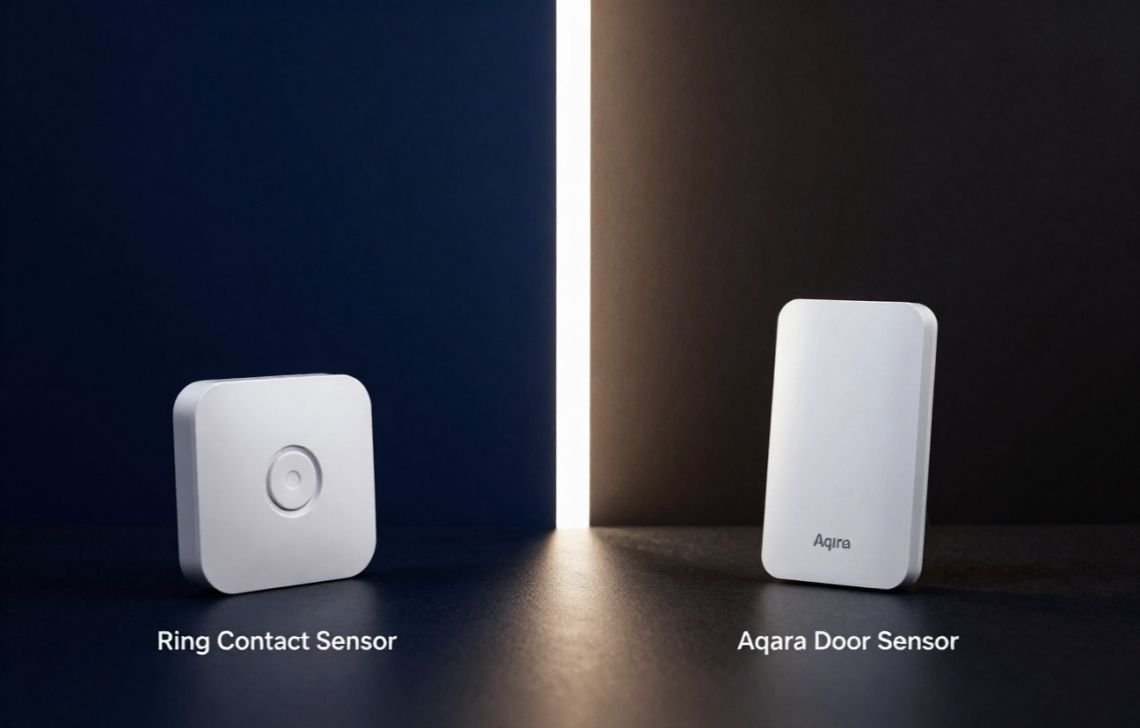
In the world of smart home security, the small things often matter the most. A simple door or window sensor might seem like a commodity, but as a privacy and automation consultant, I can tell you that the technology behind that sensor determines whether your home remains your castle or becomes a digital liability. When my clients ask me to choose between the Ring Contact Sensor and the Aqara Door Sensor, they are usually looking for a recommendation that balances ease of use with long-term reliability.
The conflict here isn’t just about hardware; it is a fundamental choice between the massive, cloud-reliant ecosystem of Amazon and the local-first, privacy-centric philosophy of brands like Aqara. On one hand, you have the sheer convenience and market dominance of Ring. On the other, you have a sensor that is consistently praised by the enthusiast community—specifically within groups like the Home Assistant community—for its reliability and autonomy.
This guide will break down everything you need to know, from the “outstanding” battery life of the Aqara to the chilling implications of being locked out of your own “smart house” for “no good reason.” By the end of this comparison, you’ll understand the critical trade-offs between a cloud-dependent system and one that keeps your data within your own four walls.
Ring Contact Sensor vs Aqara Door Sensor Comparison
For a quick overview of how these two sensors stack up based on performance data and user experiences, refer to the table below.
Feature | Ring Contact Sensor | Aqara Door Sensor |
Price | Amazon-priced/Convenience-based | Cheap |
Battery Life | Standard | Outstanding |
Primary Connectivity | Amazon-owned/Cloud-based | Local/Non-Amazon Cloud |
Reliability | Cloud-dependent / Account-linked | Works Great |
Feature Deep Dive: Cloud Connectivity vs. Local Control
As a consultant, the first question I ask any client is: “Who do you want to have the keys to your home?” This isn’t a metaphorical question. It refers specifically to the protocols and servers your sensors use to communicate.
The Ring Approach: Bound to the Amazon Cloud
The Ring Contact Sensor is explicitly “owned, made, and operated by Amazon.” In the tech world, this means the hardware and the software are inextricably linked to Amazon’s infrastructure. When a Ring sensor detects that a door has opened, that signal is sent to Amazon-operated servers. Only after the cloud processes that signal does your home automation or security alert trigger.
While this makes for a very smooth setup experience for those already using Alexa, it introduces what enthusiasts call the “YUCK” factor. The “YUCK” comes from the realization that your home’s basic security functions are dependent on a massive corporation’s server uptime and their continued approval of your account. If the internet goes down, or if Amazon’s cloud experiences a hiccup, your Ring sensors essentially become expensive plastic ornaments.
The Aqara Approach: Local Control and Autonomy
Aqara door sensors represent the alternative for users who “stay away from anything cloud wherever possible.” These sensors are designed to communicate locally. In a professional installation, this means the sensor talks directly to your home automation hub without needing to phone home to a server in another state or country.
This local-first architecture is the gold standard for privacy-centric users. It ensures that the latency is minimal—since the signal doesn’t have to travel to the cloud and back—and it guarantees that your sensors will “work great” regardless of your internet connection status. For someone building a resilient home, the autonomy offered by Aqara is the primary selling point.
Performance and Reliability Analysis
When you are installing fifty or sixty sensors throughout a large property, two things matter above all else: how well they work and how often you have to touch them.
Why Aqara "Works Great"
In the Home Assistant and hardware enthusiast communities, the Aqara Door Sensor is a staple for a reason. Users consistently report that these sensors are highly responsive. More importantly, their battery life is described as “outstanding.”
From a consultant’s perspective, “outstanding” battery life is a massive win for client satisfaction. It means fewer support calls for “offline” sensors and less time spent climbing ladders or moving furniture to replace batteries. When a sensor “works great” and stays powered for a long duration, it disappears into the background of the home, which is exactly what good technology should do.
The Reliability Gap in the Ring Ecosystem
The Ring Contact Sensor, while technically competent, suffers from a reliability flaw that has nothing to do with its radio frequency. Its reliability is tied to your Amazon account standing. Unlike the Aqara, which is a “set it and forget it” piece of hardware, the Ring sensor is on a permanent leash.
If your account is flagged, your connectivity is severed. This introduces a level of fragility that I rarely recommend to clients who are serious about their home’s security. The risk of the system failing not because of a dead battery, but because of a corporate policy or a server error, is a significant deterrent.
The "Amazon Ecosystem" Factor: Privacy and Security Risks
To truly understand why many experts are pivoting away from Amazon-owned hardware, we have to look at the ethical and practical risks of the Amazon ecosystem. The sentiment in the community is becoming increasingly firm: for many, it would be a “cold day in hell” before they trust Amazon with the “brains” of their smart home.
The Smart House Lockout Incident
The most damning evidence against a cloud-dependent system is the documented incident where a user was locked out of their entire smart home system “for no good reason.” Because Ring sensors and their accompanying hubs are “owned/made/operated by Amazon,” the company retains the “kill switch.”
In this specific case, the user found themselves unable to control their own home’s hardware because Amazon had deactivated their account. This wasn’t a hardware failure; it was a corporate intervention. As a consultant, I view this as the ultimate security breach—not by a hacker, but by the vendor themselves.
Corporate Retaliation and the "Follow-On" Effect
The risks do not stop at your front door. There is a “follow-on” incident cited in the community that should give every consumer pause. After the aforementioned user reported on their lockout, Amazon reportedly kicked them out of the Amazon Affiliate program.
This act of retaliation suggests that your relationship with an Amazon-owned smart home is a lopsided one. If you report on flaws or criticize the ecosystem, the company can and has used its broader corporate reach to penalize you. This makes the Ring Contact Sensor a liability for anyone who values their independence. It is one thing to buy a product; it is another to enter into a relationship where the vendor can “turn off” your house and your income if you speak out.
Pricing and Value Proposition
When we talk about value, we have to distinguish between the sticker price and the cost of ownership.
The Financial Value of Aqara
Aqara sensors are consistently categorized as “cheap.” However, as any professional knows, “cheap” hardware that “works great” is the holy grail of automation. Because they are cost-effective, homeowners can afford to put a sensor on every single window, cabinet, and door without a massive upfront investment. The “outstanding” battery life further increases this value by lowering the long-term maintenance costs.
The Convenience Tax of Ring
Ring sensors are priced based on “sheer convenience.” Amazon makes it incredibly easy to buy these devices—often through deals on their own site—and even easier to set them up. However, you are paying a “convenience tax” that includes your privacy and your autonomy.
Interestingly, even those who are vocal about avoiding Amazon-made hardware still acknowledge the company’s retail strength. The community consensus is nuanced: it is perfectly fine to “give them money” out of convenience for shipping or for buying other brands’ deals on their platform, but you should never buy anything made by them or that connects to their servers. The value of a Ring sensor is high for the lazy setup, but it is low for the long-term security professional.
Battery Life & Solar Charging
Eufy’s “Solar Infinity” panel is efficient but demanding. To maintain lithium health, Eufy panels require at least 2 hours of direct sunlight per day. In a gloomy Victorian winter, if the battery drops below 20%, Eufy often throttles AI scanning to save power, leaving you less protected.
Reolink’s separate panel allows you to mount the camera in the shade of an eave while placing the panel on the roof for maximum UV exposure. This placement flexibility is a major advantage for heritage homes with deep porches.
Ease of Use and Customer Support
There is no denying that for the average consumer, Ring is the easier choice. The integration with the Alexa app is seamless, and the “out of the box” experience is polished. This is the primary driver of their popularity.
However, “ease of use” can often be a trap. For those in the hardware-focused community, ease of use is defined by how well a device integrates with a local hub like Home Assistant. In that context, Aqara is the preferred choice because it allows the user to be the master of their own domain.
The Support Dilemma
When it comes to support, Amazon offers the standard corporate help desk, but the “retaliatory” actions mentioned previously suggest that this support is conditional. If you are an affiliate or a high-profile user, your ability to get help—or even keep your account—might depend on your silence regarding the ecosystem’s flaws.
In contrast, because Aqara uses standard local protocols, the “support” comes from a massive community of enthusiasts and developers. You are not beholden to a single company’s customer service line. If you have an issue, there are thousands of people in the local-control community who have already solved it.
Pros and Cons
Aqara Door Sensor
Pros:
- Outstanding Battery Life: You can go years without thinking about replacements.
- Cheap Price Point: Allows for comprehensive home coverage on a budget.
- Reliable Performance: Known across the community to “work great” without lag.
- Local Control: Keeps your data out of the cloud and functions without internet.
- Cons:
- Technical Threshold: Requires a local hub and a bit more setup knowledge for those who want to avoid the cloud entirely.
Ring Contact Sensor
Pros:
- Unmatched Convenience: The easiest possible setup for Amazon/Alexa users.
- Market Presence: Frequently available via deals and fast shipping on the Amazon site.
- Cons:
- Cloud-Dependent: Functionality is tied to Amazon-operated servers.
- Lockout Risk: Your home can be disabled “for no good reason” if your account is flagged.
- Corporate “YUCK” Factor: Deeply integrated into an ecosystem with a history of retaliatory behavior.
- Subscription Bias: Often pushes users toward a broader, paid ecosystem.
Use Case Analysis: Which Sensor Should You Choose?
The Convenience Seeker
This is the user who doesn’t want to think about hubs, protocols, or local control. They want to click “Buy Now,” peel off the adhesive, and see the sensor in their Alexa app three minutes later. Despite the “YUCK” factor and the documented risks of being “owned/made/operated by Amazon,” they are willing to accept the trade-off. For this person, the Ring sensor is the path of least resistance, provided they are comfortable with the “all-or-nothing” nature of the Amazon cloud.
The Privacy-Centric Enthusiast
This user prioritizes sovereignty. They may still use Amazon’s site to find deals on other products, but they would never let an Amazon-made device “connect to their servers.” They want hardware that “works great,” has “outstanding” battery life, and belongs to them—not a corporation. For the privacy-centric user, the Aqara Door Sensor is the only logical choice. It provides the “set it and forget it” reliability that a professional-grade smart home requires.
Final Verdict: Big Tech vs. Local Control
After analyzing the performance, the corporate history, and the technical architecture of both devices, the winner is clear. While Ring offers a seductive level of convenience, the risk of having your “smart house” turned off “for no good reason” is a dealbreaker. No amount of ease-of-use can compensate for the fact that Amazon can—and has—locked users out of their own hardware.
The Aqara Door Sensor is the superior product. It is “cheap,” it “works great,” and its battery life is “outstanding.” Most importantly, it gives you the freedom to run your home locally, away from the prying eyes and arbitrary decisions of big-tech cloud operators. If you want a smart home that is truly yours, stay away from the Amazon-operated cloud and stick with the local-control reliability of Aqara.
FAQs
If my Amazon account is flagged for a non-smart-home issue, will my Ring sensors stop working?
Yes. Because Ring sensors are “owned/made/operated by Amazon” and rely on Amazon-operated servers, they are tied directly to your account. There have been documented cases where users were locked out of their smart home devices “for no good reason” following an account suspension.
How often do I need to change the battery on an Aqara sensor?
While I cannot provide a specific month-count, the community consensus is that the battery life is “outstanding.” These sensors are significantly more low-maintenance than many cloud-based alternatives, often lasting for years in a local-control setup.
What is the “YUCK” factor mentioned in smart home circles?
The “YUCK” factor refers to the visceral dislike many enthusiasts feel toward devices that are cloud-dependent or “Amazon-owned/operated.” It stems from the privacy concerns of having your home data sent to corporate servers and the risk of being subject to corporate retaliation if you criticize the platform.
Can I buy Aqara sensors on Amazon without being part of the Amazon ecosystem?
Absolutely. As the source suggests, many users “happily steer other people towards deals on their site [Amazon]” but refuse to buy hardware made by Amazon or that connects to their servers. You can use Amazon as a retail platform for “cheap” Aqara sensors while keeping your home’s “brains” entirely local.